All posts by gaels360

Challenge to the pack

The challenge to West Coast Conference teams presented by the Big Three — Saint Mary’s, Gonzaga and BYU — remains the dominant theme as the 2016-17 season approaches. It is not merely a question of ranking the remaining seven in order behind the Big Three, it has become a test of which of them will react most effectively to the prospect of becoming permanent also-rans.

Make no mistake about it, the coming WCC season will see Saint Mary’s, Gonzaga and BYU fighting not only for conference honors and NCAA Tournament seeding,  but also for national ranking. The Gaels and Zags have been included in just about every early-preseason Top 25 calculation, with the Gaels picked as high as 14th (CBS Sports).

BYU under the radar

BYU hasn’t appeared on the national radar as yet, probably because of the typical roster changes experienced by the Cougs because of players leaving and returning from two-year missions. BYU is in “receive” mode next year, however, with both former players such as outstanding center Eric Mica, and newcomers such as TJ Haws and Payton Dastrup joining the team after completing missions.

Mica was a force for BYU as a freshman center in 2013-14 (11.8 PPG, 6.4 RPG), giving them a big, athletic post player to rival Brandon Davies. They have struggled without such a player for the past two seasons, and Dave Rose may have had flowers waiting for Mica when he returned to the BYU campus this summer.

Haws and Dastrup have yet to suit up for the Cougs, but the expectations for them are as high as for Mica. Haws, WCC fans can probably figure out, is the younger brother of former star Tyler Haws, BYU’s all-time leading scorer. He comes from the same high school as Tyler, Lone Peak in Highland, UT, and like his brother was voted Mt. Utah in his senior year. The 6-4 guard is described as a pure shooter.

Dastrup, a 6-10 power forward from Mesa, AZ, originally committed to Ohio State, but changed his mind and chose BYU. He is a 4-star, Top 100 recruit.

In addition to players coming off missions, BYU will also welcome true freshman Yoeli Childs of South Jordan, UT, a 6-7 forward who is not of the LDS faith and won’t be leaving on a mission. Childs is another 4-star recruit rated no. 50 in the country.

Together with returning point guard Nick Emery, who averaged 16.3 PPG and was named to the WCC all-Freshman Team, Rose can envision a lineup of Emery and Haws in the back court, with a front court of Mica, Dastrup and Childs. Returning front court players Kyle Davis and Corbin Kaufusi will add depth. That is a strong lineup.

Zags get Karnowski back

Gonzaga was already receiving kudos for replacing departing stars Domantas Sabonis and Kyle Wiltjer with an outstanding recruiting class before the fate of mammoth center Przemek Karnowski was resolved. Now that Karnowski has decided to return to the Zags for his senior season after missing most of last year with a back injury, Zag fans are officially in a state of bliss.

Assuming Karnowski bounces back from the back injury, he could allow Mark Few to bring along prized recruit Zach Collins of Bishop Gorman High School in Las Vegas more slowly, and not have to depend on junior Josh Edwards to improve upon journeyman status. Penciled in to replace Wiltjer is Jonathan Williams III, a transfer from Missouri, where he was the leading scorer in his freshman season.

The Zags are also anxious to see how guards Nigel Williams-Goss, a two-year starter for Washington before transferring, and true freshman Zach Norvell from Chicago, mesh with holdovers Josh Perkins and Silas Melson. A late wild card in the Zags’ guard rotation is former Cal star Jordan Matthews, who went the fifth-year transfer route to bring an additional scorer to Spokane. Few has a lot of options in his back court.

Almost an afterthought are three foreign recruits who could become impact players: Killian Tillie of France, Jacob Larsen of Denmark and Rui Hachimura of Japan. ESPN’s international player guru Fran Fraschilla has termed Tillie and Larsen “projects” for Few to develop, while comparing Hachimura to former Zag star Elias Harris. Although perhaps not ready to contribute immediately, Hachimura, Fraschilla said, is a “man-child” with “unlimited potential.”

Gaels should be better

Randy Bennett at Saint Mary’s is in the unusual position, for him, of having an abundance of talent to bring improvement to a 29-6 team that exceeded everyone’s expectations in 2015-16. Bennett is praised for getting more out of less each year than perhaps any coach in the country, but now he has some horses to try and ride back into the NCAA tournament after three straight NIT appearances.

Nothing is certain about the Gaels under Bennett’s iron-fisted control, but based on whispers in the breeze and occasional observations from insiders one can speculate on a few improvements for Saint Mary’s in the coming season. True freshman point guard Jordan Ford of Folsom High outside Sacramento has, observers note, blended seamlessly into the excellent back court of Emmett Naar and Joe Rahon.

While both Naar and Rahon were skilled at utilizing switches to beat big men off the dribble, Ford brings the ability to break down guards without a screen and get to the rim on his own. Gael fans can expect to see Ford share duties with Naar and Rahon, which should improve the Gaels’ attack and provide rest for the iron-man duo that rarely came off the court last year.

Bennett is also uncharacteristically praising the game of redshirt freshman guard Tanner Krebs, the 6-6 Aussie who sat out a year because of questions about transferability of high school courses. Some feel Krebs could challenge small forward Calvin Hermanson for minutes at the wing, which would give the Gaels an excellent tandem of three-point-shooters

Additionally, room may have to be made in the front court for sophomore Jordan Hunter. The Gaels one-two punch of Dane Pineau (11.3 PPG, 8.1 RPG in 27 minutes) and Jock Landale (8.7 PPG and 3.9 RPG in 14.5 minutes) was extremely productive last year, leaving Hunter only 71 minutes playing time. But Hunter starred for an Emerging Boomers team from Australia that went 6-0 in international competition this summer, and his athleticism may make it impossible to keep him off the floor. Just as Bennett may have to do with Ford in the back court, he may have to find ways to squeeze Hunter in along with Pineau and Landale. That says nothing about the role of true freshman Jock Perry, a 7-2 recruit who towers over all the Gael post players. It’s anyone’s guess what use Bennett makes of Perry.

Early handicapping: Gaels out front

Because he has the luxury of returning his entire lineup from last year, I would give Bennett’s Gaels a leg up on BYU and Gonzaga heading into the 2016-17 season. Bennett produced an efficient offense and stalwart defense last year seemingly out of nothing, and has all those pieces back buttressed with the confidence that comes from success. He can be expected to improve on their performance by tapping that confidence and selectively introducing new players. Gonzaga and BYU, by contrast, have to incorporate numerous new faces, and may face some adjustment issues early on.

If, however, Few settles on a lineup of Perkins, Norvell, Williams-Goss and Matthews in the back court and wing, with Karnowski and Williams III in the front court, plus reserves Collins, Melson, Hachimura and who knows else, he will have, on paper, a team to match or exceed last year’s 28-8 squad that advanced to the Sweet Sixteen.

The same can be foretold for Rose’s BYU team, which may not even miss the excellent graduated back court of Kyle Collinsworth and Chase Fischer. With a bevy of four-and-five star, Top 100 recruits, further development of the sometimes-sensational Emery and the return of Mica to the post, BYU could turn into a juggernaut.

Next time: what about the rest?

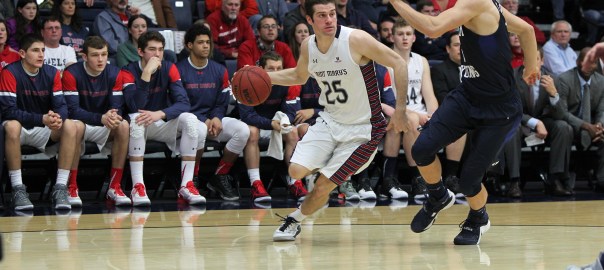
Senior Joe Rahon will lead the Gaels next year, but will get some help from freshman Jordan Ford along with fellow returning starter Emmett Naar. Photo courtesy of Tod Fierner.


Bench support

State of the WCC

It’s ironic that just as the also-rans in the West Coast Conference take steps to emerge from mediocrity, the Big Three who dominate the conference are poised to put even more distance between themselves and their challengers.

Signaling frustration after years of finishing behind Saint Mary’s, Gonzaga and BYU, leaders at Santa Clara, San Francisco, Pacific and Portland made coaching changes following the 2015-16 season. They followed Loyola Marymount by two years and San Diego by one, leaving only the Big Three and Pepperdine — which seems happy with Marty Wilson after five years — standing pat.

Questions arise when so many institutions take drastic action at once, but the most obvious one is, “What took you so long?” No one besides Gonzaga or Saint Mary’s has won a WCC championship since 2002, when Gonzaga and Pepperdine tied, and few have even challenged for the top spot in that time. BYU added a national brand to the conference when it entered in 2011, but the Cougars have never upended Gonzaga for the WCC title and have usually trailed Saint Mary’s in the standings.

As welcome as the new coaches are in such places as San Francisco, once the national face of the conference, and Santa Clara, producer of Steve Nash and others, one has to wonder how long it will take to improve their fortunes. Kyle Smith, succeeding Rex Walters at San Francisco, brings a successful tenure at the Ivy League’s Columbia and a WCC pedigree as a long-time assistant to Randy Bennett at Saint Mary’s; Herb Sendek, succeeding Kerry Keating at Santa Clara, has  big-time experience at Arizona State and North Carolina State. But Pacific hire Damon Stoudamire and Portland hire Terry Porter have no D-1 college experience and seem more like Hail Mary-plays than serious steps toward rebuilding.

On the other hand

While four WCC members were intent on soothing alienated alumni and putting fresh faces on sagging programs, the Big Three were licking their chops over unbridled opportunity. Saint Mary’s, Gonzaga and BYU all face the 2016-17 season with eager anticipation based on recent success and/or stellar recruits.

It’s definitely and/or for Saint Mary’s, which is coming off a season with the most wins in program history — 29 — including two in the National Invitational Tournament. Although the Gaels are still peeved about being excluded from the NCAA Tournament despite beating Gonzaga two times in league play, they are comforted by a situation unique in the Bennett era: they lose no one from the previous year’s squad, and will greet four excellent prospects — three freshmen and one redshirt — when practice begins officially in October.

Ever since the Gaels became serious challengers to Gonzaga in 2008, they have lost significant contributors following excellent seasons: the 08-09 squad with Patty Mills in the back court, which might have become Bennett’s best team had Mills not broken his wrist in January of 2009, lost Mills to the NBA, along with his back court mate, Carlin Hughes, and front court stalwarts Ian O’Leary and Diamon Simpson to graduation.

The 09-10 squad which went to the Sweet Sixteen said good-bye to dominating center Omar Samhan,  7-foot forward Ben Allen and back court star Wayne Hunter. The 2011-12 Gael squad which won both the WCC regular season title and the WCC Tournament championship, lost Clint Steindl, Rob Jones and Kenton Walker II to graduation.

But not so for last year’s team. One of its most surprising aspects was the absence of seniors and paucity of upper class-men — only two — in its ranks. Thus, everyone returns, led by the sterling back court of Joe Rahon and Emmett Naar, an improving post man in Dane Pineau and budding stars at both power forward — Evan Fitzner — and small forward — Calvin Hermanson. The team has size, depth, scoring ability and rebounding/defensive strength. And it will be improved in 2016-17.

Gael excitement-makers

Coming off a redshirt season mandated by an NCAA disagreement about grade transferability from Australia is Tanner Krebs, a 6-6 sharpshooter who will add to one of the Gaels’ strengths — scoring punch at the wing position. Krebs inspires visions of posting up smaller guards as well as bombing away from distance along with holdover wing player Stefan Gonzalez.

Sliding into the guard rotation, where Naar and Rahon played almost without relief due to a player shortage stemming from Krebs’ redshirt status, will be Jordan Ford, a heralded recruit from Folsom High School outside Sacramento. Ford said no thanks to scholarship offers from Cal and Gonzaga, among others, in order to play for the team that produced Mills and Matthew Dellavedova.

Boosting Hermanson’s role at small forward will be Elijah Thomas from Sunrise Mountain High School outside Phoenix, considered one of the best sleeper recruits in the West. The 6-6, 210-pound Thomas played point guard for his team, averaging 20 PPG, 6 RPG and 3 APG, but will move to the wing for the Gaels.

Adding to a deep and versatile post position is Aussie freshman Jock Perry, who may be 7-2 or even taller, but who is definitely an eye-opener walking through airports. Perry joins another Jock, the 6-11 Landale, in the post, and with 6-10 rising sophomore Jordan Hunter forms an impressive unit backing up Pineau.

Zags also stacked

Although facing the loss of NBA-capable front court stars Kyle Wiltjer and Domantas Sabonis, Gonzaga is eagerly awaiting what observers are calling its best recruiting class in team history — along with the eligibility of two excellent transfers. Ready to step in for Sabonis if injured big man Przemek Karnowski doesn’t return is 6-10 center Zach Collins from Bishop Gorman High School in Las Vegas, a 4-star, top-50-rated center.

Collins will be joined by fellow 4-star recruits Killian Tillie, a 6-10 forward from France, Jacob Larsen, 6-10, from Sweden, and Zach Norvell, a 6-4 guard from Chicago. Another highly-prized front court recruit, Rui Hachimura from Japan, is debating whether to re-classify for 2017.

Along with those newcomers are transfers Nigel Williams-Goss, a two-year starter at point guard from Washington, and Jonathan Williams III, the leading scorer for Missouri in his freshman season. Both have spent a full year in the Zag program and should be ready to play immediately for Mark Few.

BYU eager

BYU didn’t exactly stink it up last year, finishing 26-10 and advancing farther in the NIT than Saint Mary’s, losing 72-70 in the semifinals to the team than ended the Gaels’ season, Valparaiso. But hopes are higher for next year because of an excellent group of recruits and players returning from two-year missions.

Gael fans will have no trouble recognizing center Eric Mica when he returns to the post position he played extremely well as a freshman two years ago. He will have company in 6-10 freshman Payron Dastrup, a Top 100 player according to both Rivals and ESPN, and 6-8 freshman Yoeli Childs, ranked no. 50 in the country by ESPN. Another highly-rated freshman with a familiar name, 6-4 guard TJ Haws, brother of all-time BYU leading scorer Tyler Haws, will join Dave Rose’s squad after a mission as well. All told, the Cougars will have five Top 100 recruits on their roster, a first for the team.

The bottom line is the rest of the WCC may be planning for the future, but Saint Mary’s, Gonzaga and BYU feel the future is now.

Even the Gaels’ cheerleading squad returns intact for next season: (L to R) Dan Sheets, Tanner Krebs and Jordan Hunter. Photo courtesy of Tod Fierner.

Gaels roast each other at annual banquet

We knew they could shoot, dribble and rebound, but turns out these Gaels can deliver one-liners pretty well, too.

Closing out 2015-16 at the annual team banquet Wednesday night in Moraga, the players and coaches took turns taking gentle shots at each other. The unmistakable love and respect they have for one another came through the many barbs that kept the audience in stitches throughout the night.

Introduced by Franklin Porter as the player having the “sloppiest rig (worst body) on the team,” Jock Landale was unruffled. Looking elegant in a well-tailored grey suit and glasses that seemed tiny atop his 6-11 frame, Landale said he was fine with his body because he had “the most attractive face” and was the best-dressed.

Emmett Naar, who donned a jaunty bow tie along with several other Gaels, had the job of introducing his longtime friend and teammate Dane Pineau. Deadpanning beautifully, Naar announced, “I don’t really like Dane.” He went on to praise Pineau’s great nose for the ball, adding that his fellow Aussie actually “has a great nose for everything.”

When it was his turn to introduce teammate Joe Rahon, Pineau returned Naar’s barb by commenting that although “he’s nearly 22, he still gets 12-and-under tickets.” Rahon, on the other hand, gets senior rates, Pineau quipped, and is in bed by 9:30. And so it went.

Rahon called out walk-on guard Jack Biebel, whom Gael fans see only in garbage time and other specialized moments, as “the healthiest guy I know.” Biebel ate so many carrots, Rahon said, that he turned orange at one point in the season, becoming “the first Oompa Loompa on the team.” Praising the impact Biebel’s healthy eating habits had on his teammates, Rahon said Biebel “turned fat Emmett Naar into chubby Emmett Naar.”

Rising sophomore center Jordan Hunter revealed something of fellow soph Evan Fitzner’s attendance habits, commenting, “Fitz is 47% from the field and about the same percentage in the classroom. If we had two banquets, I know Fitz would be up for only one.”

Coaches into the act

The players weren’t the only ones trading jibes. David Carter, who could have a career as a stand-up comedian as well as a coach, noted that Naar should be friends with Pineau because of the many times Pineau made up for Naar’s defensive lapses by blocking shots taken by Naar’s man. He mimicked Naar standing still as his man went around him, then thanking Pineau for bailing him out.

For all the humor, Carter didn’t try to hide his admiration for Pineau’s defensive toughness. He recalled one moment from last season when the Gaels called a time out and Pineau came to the sidelines bleeding profusely from his nose. “He was yelling and firing everyone up while his nose was bleeding,” Carter said. “He doesn’t back down from anything. I never had a guy [like Pineau] who brought it every time,” remarked the coach who has been coaching for 17 years, including six as head coach of Nevada-Reno.

Head coach Randy Bennett, guided by the flawless emceeing of Bay Area TV sports reporter Matt Maiocco (Comcast Sportsnet), reacted humorously to a question about the dubious foul on Gonzaga guard Eric  McClellan in the final seconds of the Gael victory over the Zags in Moraga.

“Oh, so that’s down to me,” Bennett said. Referring to Rahon, who committed the foul, Bennett commented, “You would think that a guy who was an academic all-American could count to seven.” He also chided Rahon’s back court mate Naar for not alerting Rahon to the fact that the Gaels had already committed six fouls, then seemed to re-think the situation.

“Those guys (Naar and Rahon) were pretty smart,” he said. “They knew McClellan was going to miss the free throw.”

Bennett’s observations

Bennett was also serious at times, particularly in response to a question from Maiocco about whether he anticipated the success of last season’s team (29-6).

“No,” he said. “The only thing I knew was how committed they were to playing the right way. From day one they had a great attitude. They were the best I’ve ever had at that. I didn’t know what that would lead to, but it’s rare in college basketball. They get it. It’s a team sport.” He praised the parents  of all his players for raising them right and added that he’s “never had a better group” in his 15 years at Saint Mary’s.

Asked by Maiocco when he realized they might be pretty good, Bennett said early-season scrimmages with Pac-12 teams Washington and Arizona — both of which the Gaels won — made him think they could be successful. By the time the Gaels played California (Dec. 12 ), “I thought we could be good,” he said. Even though the Gaels lost to Cal 63-59, Bennett said the game was a milestone. “The guys thought they should have won.”

Bennett repeated his criticism of the NCAA Selection Committee and its decision not to award the Gaels a bid to the NCAA Tournament despite their outstanding record. “It’s a moving target” to meet the NCAA Selection Committee’s criteria, which are never made clear to college teams, Bennett said, adding the field should be determined solely by RPI ratings. “Basketball is the only college sport with a selection committee,” he noted.

He expressed confidence that Saint Mary’s and Cal would continue playing each other in the future, although the details remain undetermined. “I’m pretty sure we’ll have a series with Cal,” although “they want to do it on their terms,” he commented. “We’ll get them at home one of these years.”

Noting the home game against Stanford last year, which the Gaels won handily, and a rematch at Stanford in 2016, Bennett said, “We’ll play those two teams (Cal and Stanford) on a regular basis. Maybe Cal at our place every other year, maybe every third year. In a few years, it’ll happen.”

Accolades

Their were also moments to honor individual players during the night. Bennett got the ball rolling, in  a way, with his introduction of redshirt freshman Tanner Krebs, the Australian sharpshooter who spent his first year in Moraga riding the bench. Krebs was sidelined, Bennett said, because of “the funny way the NCAA looks at transcripts,” meaning there was some question about how Krebs’ academic record in Australia matched NCAA requirements. The same issue forced Naar to sit out his freshman season.

I erred in an earlier post about the Gaels short-handed situation in the back court caused, I said, partly by Bennett’s decision to redshirt Krebs. Turns out the decision was made by the NCAA, not the coach.

Even though it was a setback, Bennett said Krebs handled the NCAA ruling “as well as he possibly could.” Bennett rarely praises untried players, but said of Krebs, “This guy can play” and he gives the Gaels “a chance to be a little better next year.” For those who specialize in deciphering Bennett’s sometimes cryptic comments about Saint Mary’s in general and players in particular, that constitutes a rave. Keep an eye on Mr. Krebs in future years.

Formal awards went to Calvin Hermanson for Most Improved Player, to Pineau for Defensive Player of the Year and to Naar and Rahon as Outstanding Leaders. Gael assistant coach Marcus Schroeder, in presenting the award to Hermanson, rattled off several stats illuminating Hermanson’s improvement between his freshman and sophomore seasons, including minutes and points per game. Schroeder struck a chord which seemed to epitomize the challenge to the Gaels going forward with a quote about Hermanson’s achievement:

“Change is inevitable, growth is optional,” Schroeder quoted.

The Gaels made that choice consciously in 2015-16. It’s seems likely they will continue to make it in the years ahead.

Emmett Naar and Joe Rahon are already one of the best back courts in the nation. The photo above indicates they may be making sartorial news as well. Photo courtesy of Tod Fierner.


A Ford in Gaels’ future

Jordan Ford was not selected as the Sacramento Bee‘s Player of the Year for the Sacramento area earlier this month. This is news because Ford won the honor after his sophomore and junior years, and compiled a senior season equal to or surpassing any of those preceding it.

As in, 19.7 PPG and 3.9 APG compared to 19.7 PPG and 3.2 APG in his junior year, or 22.5 PPG and 3.5 APG in his sophomore year. He is boringly consistent and consistently excellent, but the Bee gave the nod to Sacramento High’s impressive power forward Solomon Young, perhaps because Young’s team defeated Ford’s Folsom High team in the state championship tournament.

It was some consolation for Ford to wind up on a Sacramento area all-star team along with Young this past weekend. Also joined by Young’s teammate from Sac High, guard Christian Terrell, and Ford’s Folsom back court mate, Tre Finch, Ford found himself on the “South Team.”This was fortunate because the South squad was far superior to the “North Team.” In fact, the game pitted metro-area stars (South) against those from Sacramento’s outlying areas (North), and the city boys were bigger, quicker and just plain better.

How Ford ended up on the city squad despite playing for Folsom in the Sacramento boondocks was not disclosed, but the combination of him, Young and Terrell was too much for the opposition. Ford, going to Saint Mary’s, Young, going to Iowa State, Terrell, going to UC Santa Barbara, and Tiegen Jones of Sacramento’s Capital Christian High School, headed for Fresno State, were the college-bound headliners in the contest.

The North Team (country mice) boasted a Howard commit, Kai Tease of Antelope High School, and UNR commit Charlie Tooley of Granite Bay High School, but otherwise were out-manned.

Ford shines

Ford appeared to me to be the most polished player of the 27 all-stars. He started so fast, sinking four straight three-pointers before fans had settled into their seats, that South coach Derek Swafford, a veteran Sacramento-area coach, felt obligated to bench him around the half-way mark of the first period. High school games consist of four, eight-minute quarters, but they played 10-minute quarters in the all-star contest. A companion and I quickly began playing “over-under” for the game, and settled on opposite sides of the 150-point mark.

We weren’t far wrong, as the South totaled something north of 130 points, while the North was considerably behind, although over 100 as well. There were no stats available for the game, and the Bee, which used to pride itself on being a comprehensive local newspaper, ignored the result in Sunday’s paper. So, point totals and other stats were left to guesswork, and I put Ford’s total in the 22-26-point range. That’s playing less than half the minutes available to him.

My first observation is that he is taller in person than photos and videos have indicated, with a long and lanky frame, including arms, that put him close, in my estimation, to Emmett Naar’s 6-1. Most rating services put him at 6-feet, however, and I’ve never heard of a player being listed at less than his actual height. So, let’s stick with 6-feet, but don’t be surprised if that is adjusted upwards.

He is a truly gifted shooter, with an effortless release that is superior to either Naar’s or Joe Rahon’s, and is comparable in form to Stefan Gonzalez, Evan Fitzner and Tanner Krebs. Add another sharpshooter to Randy Bennett’s collection of gunslingers. His shooting range extends from three-point land to mid-range pull-up jumpers, teardrops and driving lay-ups. During his high school career, Ford shot 58, 56, 56 and 49 per cent on two-pointers, and 37, 39, 42 and 41 per cent on three-pointers. He shoots with the calm confidence of a player who is used to seeing the ball go through the net.

At the point

Ford is a scoring point guard, and he mans the point position with the intention and ability to drive with either hand. He didn’t pass much in the all-star game,  but he hardly knew his teammates so that means nothing. He executed a flawless pick-and-roll with Young that would have brought a smile to Bennett’s face had he been in attendance. His overall handle is excellent, he brings the ball up-court with his head up and surveys the entire floor. He is the complete package.

Gael fans will undoubtedly spend many hours this summer wondering how, and if, Bennett will incorporate Ford into the Naar-Rahon back court that gobbled up 99% of the available guard minutes in 2015-16. My guess is he will become part of a three-man guard rotation, spelling either Naar or Rahon for short periods. This will get him acclimated to the Gaels’ offense before Rahon graduates and provide a breather for the two iron men whether they want one or not. If Ford adapts to D-1 play as effortlessly as I think he will, this arrangement will make the Gaels a better scoring team and keep Naar and Rahon fresh for a post-season run.

It’s a pleasant prospect.

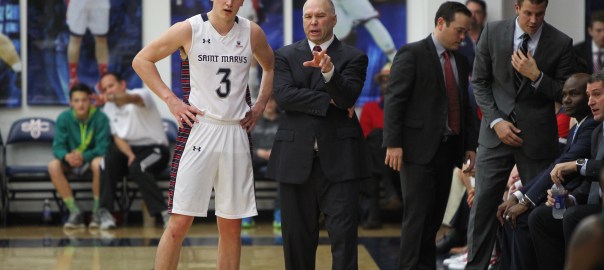
Gaels coach Randy Bennett didn’t spend much time on the sidelines with Emmett Naar and Joe Rahon last year, but he may see more of them in 2016-17 if Jordan Ford makes the kind of impression expected of him. Photo courtesy of Tod Fierner.

Rules of succession

Although significant for achieving the 29-win mark for the first time in program history, the 2015-16 Gaels did not separate themselves markedly from some of their predecessors. In a five-year span from 08-09 through 12-13 — four of those under the direction of Matthew Dellavedova — the Gaels went 28-7, 28-6, 25-9, 27-6 and 28-7.

That’s consistency, and until the wheels fell off the Bennett Express in a two-year hiccup between 2013 and 2015, it placed the Gaels in rare company among NCAA D-1 programs. For all that success, however, Saint Mary’s did not win consistently in the post-season — a trait that leads to national recognition, boatloads of NCAA dollars spread among WCC schools and appreciation from the eastern-dominated sports media.

This is where he current squad can distinguish itself — by launching an unprecedented run of success in NCAA Tournament play.

There for the taking

The team closest to the current squad in terms of potential was the 08-09 group led by Patty Mills that racked up the nation’s longest winning streak at 15 straight, was ranked either 18th or 22nd in the national polls and roared into Spokane on Jan. 29, 2009 intent on knocking off the Zags and establishing themselves as the new kings of the WCC.

All went well until the three-minute mark of the first half when Mills slipped on the Gonzaga floor and broke his fall with his right hand. Unfortunately, he also broke his right wrist on the play and took the Gaels’ high hopes with him to the bench for the next several weeks. Mills was nothing if not game, and rehabbed himself in time for a specially-arranged game against Eastern Washington on March 3 that the Gaels won 85-65, Mills scoring 19 points in the romp.

“See, dear Selection Committee members, our star player is all better and we’re ready for the NCAA Tournament,” was the Gaels’ message, but the Selection Committee did not buy it. It frowned on the Gaels’ loss to Gonzaga in the WCC Tournament championship and declined to offer the Gaels an NCAA bid. They were relegated to the NIT.

That snub notwithstanding, the Gaels were primed for continued success next season even though Mills opted for the NBA draft after two years in Moraga. A little-used substitute point guard named Mickey McConnell had stepped into Mills’ shoes upon Patty’s injury and proved himself a worthy successor. Teaming up with a freshman Aussie, Dellavedova, McConnell led a squad including Omar Samhan, Ben Allen, Clint Steindl, Jorden Page and Wayne Hunter to the Gaels’ most successful post-season ever — a Sweet Sixteen match in Houston against Baylor. Never mind the 22-point loss to Baylor, the Gaels had established a new benchmark and were looking to the future.

Dreams of becoming a consistent deep NCAA competitor dissolved next year, as the loss of Samhan proved too costly even though Rob Jones moved forcefully into the front court to bolster the McConnell-Dellavedova back court. It was back to the NIT for the 10-11 squad, where it suffered an inexplicable 71-70 loss to Kent State on, of all things, a blown lay-up at the buzzer by McConnell.

Resurrection

2011-12, the first year of BYU’s participation in the WCC, proved memorable for the Gaels, as redshirt freshman Brad Waldow took Samhan’s place on the front line and helped Saint Mary’s to resounding early-season wins over BYU (98-82) and Gonzaga (83-62). That team won not only the regular-season WCC title but also the conference tournament, and steamed into the NCAA Tournament for a first-round match against an eminently beatable Purdue team that had gone 21-12 in the regular season to the Gaels’ 27-5.

That was a moment for the Gaels to establish themselves as NCAA powers, following up a Sweet Sixteen performance two years before with another couple of first-weekend wins. It all came tumbling down, however, as Steindl committed a blunder for the ages on an in-bound pass in the game’s waning seconds with the Gaels up by one. All the Gaels had to do was in-bound the ball, take a foul by Purdue and make free throws to ice it. Steindl suffered a mind-freeze, however, illegally ran along the baseline on the in-bound attempt and gave the ball back to Purdue. That allowed a Purdue guard to make the game-winning free throws and the Gaels to contemplate “what if.”

Showing resiliency in 2012-13, Delly’s last year, the 28-6 Gaels wangled an at-large NCAA bid, albeit one requiring a play-in game against Middle Tennessee State, won that and moved on to Auburn Hills outside Detroit for a game against another beatable team, Memphis. Another head-scratching performance, however, ended the season with a 54-52 loss to Memphis, which proved to be the Gaels’ last NCAA appearance.

Which brings us to…

Three years removed from NCAA post-season play, the 2016-17 Gaels have an opportunity last shared by the 09-10 team: follow-up a two-NIT-win campaign with an NCAA bid and redeem those dreams first invoked by the Sweet Sixteen performance. Even more than the 2010 squad, however, the current team is primed for success. Not only will they not suffer a loss similar to Mills’ NBA defection, they will not lose a single player to graduation.

No Mills going pro, no Samhan graduating, the 2016-17 Gaels return an entire starting five, plus proven bench players, plus an outstanding recruiting class. The NCAA has seemingly put additional pressure on mid-major teams like Saint Mary’s by drastically reducing the number of at-large bids extended to them, but the Gaels are strong enough to take on a Power Five conference foe or two in the pre-conference season. That should make the Selection Committee happy and give the Gaels an optional route to the Dance if they can’t wrestle an auto bid from the claws of WCC competitors Gonzaga and BYU.

It’s no longer about restoring high-water marks such as 25-win seasons that had become commonplace with the Gaels, the future is about success during March Madness. Saint Mary’s was knocking on the door of post-season consistency in the 2010-13 era, and now has an opportunity to exceed that performance and set a new standard of excellence.

Gael coach Randy Bennett will lead the same team of players and coaches next year as he did during this year’s 29-6 campaign. Photo courtesy of Tod Fierner.

Pineau in the paint.

What they did

Now that 2015-16 is officially over and George Washington did what the Gaels should have done in dispatching Valparaiso 76-60 in the NIT title game, it’s a good time to reflect on what Saint Mary’s accomplished this season and what can be expected next year.

They did very well.

That may seem an overstatement considering Randy Bennett stitched together a transfer guard from Boston College, a sophomore Aussie guard who underwhelmed towards the end of his freshman season, a redshirt freshman who had never played in a DI game and three part-time players from the previous season. But Bennett stitched them together to the tune of a 29-win season that was the most in Gaels’ history and that vaulted Saint Mary’s to the top of the NCAA DI national statistics.

First in field goal percentage (50.4%), first in assist-to-turnover ratio (1.74, nosing out Michigan State), fifth in defense (60.9 PPG) and ninth in three-point percentage (40.6%). The little school from Moraga, which was not deemed worthy of inclusion in the NCAA Tournament, led in two national statistical categories and finished in the top 10 in two others. Yeah, they did well.

Drilling down to the individual level, the Gaels produced four starters who averaged double-digits — Emmett Naar (14 PPG), Dane Pineau (11.3 PPG), Calvin Hermanson (10.9 PPG) and Joe Rahon (10.7 PPG). That redshirt freshman, Evan Fitzner, averaged 8.7 PPG in a little more than 23 minutes per game, and Pineau’s back-up, Jock Landale, contributed nearly 8 PPG in fewer than 15 minutes per contest.

Just to add a little spice, true freshman Stefan Gonzalez made 40-76 three-point attempts for a gaudy 53% playing about 10 minutes per game.

How they did it

Bennett’s team epitomized efficient offense and tenacious team defense. He put two pure point guards, Naar and Rahon, on the floor at the same time, and gambled that they could complement each other, not get in each others way. They succeeded brilliantly, compiling that nation-leading assist-to-turnover ratio and turning the Gaels’ one-two center tandem of Pineau and Landale into a daunting force in the paint, with Pineau finishing ninth in the nation in field goal percentage at 67% and Landale following close behind at 61%.

Pineau and Landale gave the Gaels nearly 20 PPG and hardly ever missed a field goal attempt because Rahon and Naar executed the high pick-and-roll to such a degree of success that they scored mostly on lay-ups over out-of-position defenders. Hermanson and Fitzner benefited from kick-out passes from the paint and were free to score from long distance to keep the middle from getting jammed up.

It wasn’t a perfect formula as defeats at the hands of inferior teams such as Pepperdine and Valpo demonstrated. The Gaels’ offense could get stuck, and they sometimes seemed unable to execute Plan B when Plan A wasn’t working. Bennett will undoubtedly spend most of this summer tinkering with his formula and deciding how to avoid offensive lapses next year when the Gaels will have a giant target on their backs.

Lots to tinker with

The key is “tinkering” rather than overhauling. All Gael players from 2015-16 return next year, and three recruits and a redshirt will join the party. Bennett undoubtedly faces pressure to work an outstanding point guard prospect, Folsom High’s Jordan Ford, into his back court, to find a place for a 6-5 leaper from Arizona, Elijah Thomas, and work a 7-2 Aussie center, Jock Perry, into the post position manned so capably by Pineau and Landale.

As if those weren’t enough options, Bennett has another 6-10 post player, Jordan Hunter,  lurking in the background, and 6-6 shooting guard Tanner Krebs coming off redshirt status. Only five players are allowed on the court at a time, so Bennett has some work to do in juggling a loaded roster.

He won’t be the only WCC coach with such a problem, as the Gaels’ main opponent, Gonzaga, also faces roster challenges. The Zags, who won the NCAA bid Saint Mary’s coveted by beating the Gaels in the WCC championship game — after losing both regular-season match-ups — have a six-man recruiting class coming to Spokane, and two redshirt transfers, Nigel Williams-Goss and Jonathan Williams III, becoming eligible.

Complicating Mark Few’s calculations is the uncertain status of the Zags’ two top centers, Przemek Karnowski and Damontas Sabonis. Sabonis could opt for the NBA draft, as could Karnowski, or  both could decide they like the training table in Spokane. That would create a logjam similar to the Gaels’ at center, with 7-1 Ryan Edwards returning and four-star prospect Zach Collins of Bishop Gorman in Las Vegas, enrolling in the fall.

Few also faces a crowded front court despite the graduation of superstar Kyle Wiltjer. Williams III was Missouri’s top scorer (12 PPG) as a freshman, and has spent a year rehearsing to be Wiltjer’s replacement. The Zags also recruited forwards Killian Tille from France, Jacob Larsen from Denmark and Rui Hachimura from Japan. Few may decide on a roster based on who can  understand him best in practice.

Zags-Gaels contrast

While Bennett faces tinkering with a mostly set lineup, Few could field an entirely new team next year. Williams-Goss was a McDonald’s All-American who started, and starred, for two years at Washington, and is undoubtedly taking aim at Josh Perkins’ starting point guard status. Freshman Zach Norvell is a flashy, 6-5 shooting guard from Chicago who must make Silas Melson extremely nervous.

If both Sabonis and Karnowski depart for pro ball, Few could be left with the freshman Collins in the post, backed up by Edwards. Figure Williams III for one forward spot, another of the foreigners at the second, and a back court of Williams-Goss and Norvell, and Zag fans will need to consult their programs to figure out who’s who.

This problem of rosters overloaded with potential stars did not happen by accident. Gonzaga is coming off back-to-back strong NCAA runs — a loss to national champion Duke to keep them out of the Elite Eight two years ago and a loss to NCAA title contender Syracuse in the Sweet Sixteen this year — and has no NIT plans for the future.

Bennett has weathered the brunt of NCAA sanctions that cost him four scholarship players over the past two seasons, and will hand out a full complement of 13 scholarships in 2016-17. The Gaels have already landed an outstanding Australian guard, Angus Glover, for 2017, and have their sights set on additional stars in the future. Both Bennett and Few are fully involved in an arms race for supremacy in the WCC and success in the NCAA Tournament.

Their battles, along with competition from always-excellent BYU, will be the main focus of interest in the WCC and the west for the foreseeable future, despite upgraded coaching positions at Pacific (Damon Stoudamire), Santa Clara (Herb Sendek), San Francisco (Kyle Smith) and Portland (Terry Porter). Those schools are playing catch-up with the success of Saint Mary’s, Gonzaga and BYU, and the results of their efforts will take several years to bear fruit.

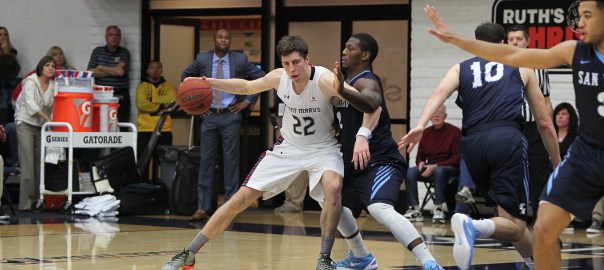
Dane Pineau will begin next season as one of the best big men on the West Coast, following a junior year in which he shot 67% from the field, ninth best in the country. Photo courtesy of Tod Fierner.

And so it ends

With a 13-point second half.

Built on 6-29 shots made (20.7%) from the leading offensive team in the country, which averaged more than 50% shooting over an entire season.

Inexplicable. Maddening. A 60-44 loss after 29 wins, the most in Saint Mary’s history.

Valparaiso is undoubtedly a very good team, with an intimidating shot blocker in Vashil Fernandez who single-handedly demoralized Randy Bennett’s intricate, usually efficient offense (six blocks). Faced with unusual pressure inside, the Gael bigs, Dane Pineau, Jock Landale and Evan Fitzner shot a combined 9-21.

In a game that cried for three-point shooters to make shots to loosen up the interior, Calvin Hermanson and Fitzner were 2-8 on three-point attempts. Emmett Naar and Kyle Clark, sometimes effective outside shooters, were 0-6, while Joe Rahon never even attempted a three-pointer. Only freshman Stefan Gonzalez, repeating his outstanding performance against Georgia two days earlier, showed the ability to sink long-range shots. He made 3-5 three-pointers, but it was too little, too late.

A total breakdown such as the Gaels experienced in the second half (they led 31-29 at the break) defies explanation. Everything went wrong, nothing worked. Valpo hardly exploded in the second half, scoring 31 to go with its first-half 29, but the Gaels simply couldn’t make a shot.

Options for next year

The Valpo disaster aside, Gael fans will look back on the 2015-16 season with pride and excitement for the future. An almost totally untested team beat Gonzaga twice, tied the Zags for the WCC title and beat two teams in the NIT. Based on success achieved 29 times, Bennett knows what works with this group. The question is, did he learn from the Valpo meltdown how to make the recipe better so his team can avoid a Valpo-like disaster when they reach the post-season next year?

Bennett can go either one of two ways. He can brush off the Valpo loss as just a quirk, a one-game hiccup that shouldn’t have an undue influence on how he moves forward. In that scenario, he can count on improved play from Fitzner next year — a player’s biggest growth is between his freshman and sophomore years — a veteran returning back court, and hoped-for contributions from heralded  newcomers Jordan Ford, Elijah Thomas and Jock Perry. That’s the stand pat approach.

Another option is to make a leap of faith and experiment with different combinations next year, combinations that will make the Gaels less predictable. It would seem to be a waste of talent if Bennett cannot find ways to incorporate the skills of guards Tanner Krebs and Franklin Porter, newcomer Ford and a re-imagined Gonzalez in his attack next year. The Naar-Rahon probe and dissect game was brilliantly effective this year,  but it got stale and cried out for someone who could make a big play by himself and not just through the system.

Clearly, Gonzalez is a gifted shooter with ice water in his veins and a flare for the dramatic. Can’t he be used more effectively? Krebs is a 6-6 guard, who one can envision posting up opposing guards in addition to scoring from afar. Ford is a shifty prober who can also shoot both mid-range and long-range jumpers. Porter is a big-bodied guard who seems to have potential as a perimeter defender.

That’s a ton of talent for Bennett to tinker with, but his options don’t stop there. Thomas, the high-flying 6-5 guard from Peoria, AZ (outside Phoenix), could be a valuable addition to the Hermanson-Clark tandem at small forward. Can Bennett push his rotation to include Thomas, or should he redshirt him?

A similar question arises in the front court, where Pineau, Landale and freshman Jordan Hunter all return, to be joined by 7-2 Jock Perry. Does Perry have scoring ability beyond the lay-ups and occasional post-up moves from Pineau and Landale? Does Bennett take on the headache of fitting still another big man into the rotation, or does he take the safer route of redshirting one or two of the bigs?

29-6 is not good enough

These questions are important because Saint Mary’s cannot play the timid waiting game next year that they did — successfully — this season. There will be expectations attached to the 2016-17 squad, and Bennett’s job will be to realize those expectations with an NCAA bid and extended run.

The NIT experience should pay dividends next year. New Mexico State was nothing special, just a re-visit of a team and conference the Gaels have dominated in recent years. Georgia was a good test in that it was an athletic team from a superior conference. Valpo was also a good test, one the Gaels seemed to be on the verge of passing. They were smooth and confident in the early going against Valpo, and seemed capable of extending their run into the NIT semifinals in Madison Square Garden.

But the wheels came off against Valpo in the second half, and Bennett has six months to ponder how he can avoid that happening next year when he will be seen as leading a powerhouse. Powerhouses don’t fold in the second half against teams with no obvious superiority. Powerhouses shift into another gear when things get stuck, and the Gaels showed that they were unable to do that. Changes should be made to ensure there are no similar collapses in the Gaels’ future.

Calvin Hermanson, the Gaels’ occasional ace, was not a factor in the loss  to Valparaiso. Photo courtesy of Tod Fierner.

This is getting interesting

No more the hesitant, seemingly-distracted Gaels who limped to a 58-56 win over New Mexico State in the NIT opener, Saint Mary’s dispatched a strong Georgia Bulldogs squad 77-65 Sunday afternoon, and got on a plane to Valparaiso, IN for a Tuesday  contest that could send them to the NIT semis in Madison Square Garden.

The Gaels were ruthlessly efficient against Georgia, which beat SEC foes Georgia Tech, Missouri, Tennessee and South Carolina this season, and pushed Kentucky before succumbing to John Calipari’s talented Wildcats in the SEC tournament semifinal. Georgia didn’t plan on losing to Saint Mary’s, and rode its duo of Yante Maten and J.J. Frazier to what it hoped would be its own ticket to New York.

Instead, Maten found difficult sledding inside against Dane Pineau, Jock Landale and an energized Evan Fitzner, as he struggled to 12 points on 6-22 shooting. You read that right — Maten missed 16 shots. Pineau and Landale combined for 18 points and 13 rebounds between them, while Fitzner pulled down seven ferocious rebounds to go with 13 points.

Frazier fared little better competing against Gael guards Joe Rahon and Emmett Naar, scoring 13 points on 5-15 shooting. Rahon and Naar cruised to 28 points between them, with Naar consistently befuddling Georgia in the paint as he dished 11 assists to one turnover. The Gaels totaled 19 assists on 29 made baskets, shooting 50% from the floor against one of the stingiest defenses in the country.

Fitzner on fire

If there was a poster boy for the Gaels’ win over Georgia it was Fitzner, the talented redshirt freshman who plays like, well, a freshman, at times. Fitzner sleepwalked to a two-point, five rebound effort against New Mexico State, but had fire in his eyes against Georgia. He pounded the boards early, then nailed three three-pointers in the second half when the Gaels staved off a strong Georgia rally that brought the Bulldogs within four points of the lead.

Another Blast from the Past was provided by true freshman Stefan Gonzalez, who had gone MIA in recent weeks after announcing himself as one of the brashest, most deadly three-point shooters in the Gaels’ arsenal. Gonzalez came off the bench early in the first half and sank three straight three-pointers that gave the Gaels confidence early.

Pineau, who has become a double-double machine, put in another workmanlike 12-point, 11-rebound effort. His ability to defend and rebound without fouling out, then score inside when the opposition forgets about him has made him one of the Gaels’ most potent weapons. Landale, who was splitting time almost evenly with Pineau early in the season, gets fewer minutes these days but has not let it affect his performance.

The Gaels will be tested against Valparaiso, which has dominated the Horizon League the past two years as Alec Peters has become a conference beast. Peters, the 6-9 junior who became a one-man highlight reel by converting an 80-foot desperation pass at the end of regulation against Green Bay in the Horizon League conference semifinal (Valpo lost in overtime), averages 18.5 PPG and 8.4 RPG.

He combines with 6-10 shot-blocker Vashil Fernandez, who averages 5.6 blocks-per-game, to give the Crusaders a truly potent inside game.

Valpo, which failed the NCAA road opponent test, ventured outside the Midwest infrequently this year, visiting Oregon and Oregon State for back-to-back games — a 76-67 loss to Oregon and a 63-57 win over Oregon State. Valpo also lost at Belmont, 85-81; Belmont took Georgia to the wire in an earlier NIT contest before losing 93-84.

Valpo, which is a private Lutheran college of roughly Saint Mary’s size, plays its home games in a snug, 5,400-seat facility inventively named the Athletics-Recreation Center (the ARC). Based on earlier NIT results, including Crusader wins over Texas Southern and Florida State, it will be rocking for the ESPN telecast against the Gaels at 4 p.m. Pacific.

NIT field

As the NIT moves into the quarterfinal stage, some interesting potential match-ups loom. BYU has breezed past its two initial opponents, UAB (97-79) and Virginia Tech (80-77), and faces Creighton in Provo the same day as the Gaels face Valpo. If both BYU and Saint Mary’s prevail Tuesday, they will face each other in the NIT semifinal in New York on March 29.

Slouching towards Gotham on the other side of the bracket are South Carolina, Georgia Tech, Washington, San Diego State and NCAA reject Monmouth, among others. If either Washington or San Diego State make it to the semis, it could be an all-western shootout in the Garden.

The Gaels’ Evan Fitzner, shown above driving the baseline, came up big against Georgia. Photo courtesy of Tod Fierner.

Pineau in the paint.

Rainy night for Georgia?

Dave Flemming, who as a basketball analyst makes a good baseball announcer, pronounced the Belmont Bears “perhaps the team most similar to Saint Mary’s in the country” during ESPN’s Wednesday telecast of the Belmont-Georgia NIT contest.

Really, Dave? And is that Sergio Romo warming up in the Giants’ bullpen?

Let’s consider one key difference between Belmont, who fell to Georgia 93-84, and Saint Mary’s: the Gaels play a little defense.

Flemming could have made a better comparison if he stood Belmont side-by-side with BYU, which shares a similar overall philosophy with the Bears — don’t worry how much the other guy scores, just score more (that philosophy was on full display Wednesday night as BYU blitzed Alabama-Birmingham 97-79) . Belmont, which has become an institution in Nashville, TN under the eternal guidance of Rick Boyd — 35 years is an eternity in college hoops — scores more than 82 PPG, but gives up 78.4. The Gaels give up 60.8 PPG, and do that grudgingly.

This is relevant to the Gaels’ Sunday contest against Georgia in Moraga because Georgia looked like an NBA team against Belmont, scoring 93 points. What Gael fans have to consider is, “How much will the Bulldogs score if someone tries to stop them?”

Scary lineup

Georgia, operating somewhat successfully under former Nevada coach Mark Fox in a football-crazed region, has a scary lineup headed by 6-8. 240-lb. sophomore forward Yante Maten (16.7 PPG), 6-5, 215-lb. guard Charles Mann (10.8 PPG) and 6-3, 205-lb. guard Kenny Gaines (13.2 PPG). Not as physically imposing but more talented offensively is leading scorer J.J. Frazier, a smooth 5-10 guard leading the Bulldogs in scoring at 17 PPG. That’s a lot of size and firepower. All four were on full display against Belmont, and all of them looked impressive, especially Maten, who exceeded all previous performances by scoring 33 pts. and corralling 10 rebounds.

Fox has led this crew to a 20-11 record overall, 10-8 in the powerful Southeastern Conference populated by teams with names like Kentucky, Texas A&M and Vanderbilt. The Bulldogs made it to the semifinals of the recent SEC Tournament (I erred earlier by saying they made it to the final game), losing to Kentucky by a closer-than-it-sounds score of 93-80. Patsies they aren’t.

Despite Maten’s explosion against an undersized Belmont front court, the Gaels’ most difficult match-ups will be at the guard positions. Mann, at 6-5, is the kind of big, strong guard that has given Saint Mary’s problems this year, similar to Gonzaga’s Josh Perkins. Gaines, a solid 6-3, is another load, and Frazier is a quick penetrator. The hard-working Gael crew of Joe Rahon, Emmett Naar and Calvin Hermanson/Kyle Clark will have to slow this trio down if the Gaels are to advance.

Fox knows his way around

For Georgia’s Fox, the Sunday afternoon in Moraga may be reminiscent of a New Year’s Eve 2005 engagement between the Nevada Wolfpack he was then coaching and Randy Bennett’s Gaels. Nevada was ranked 20th in the nation at that time, but fell victim to one of the Gaels’ all-time offensive performances by Brett Collins, who scored 31 points in an 89-80 Saint Mary’s win.

Fox, who was on the Nevada staff for nine years, five as head coach, got his revenge the next year when the Gaels traveled to Reno for a rematch and were defeated 76-58. One of the assistant coaches during Fox’s tenure was current Saint Mary’s assistant David Carter, who succeeded Fox in the top spot before coming to Saint Mary’s this season. There are connections between the two programs, and Fox may be able to soften the culture shock his troops might experience in coming from their spacious, student-filled facility in Athens, GA to cramped McKeon Pavilion and an uncertain student audience that seemingly hasn’t figured out what the NIT excitement is all about.

One thing it is about is staying home as long as possible. The Gaels are a second seed in their NIT bracket, but the no. 1 seed, Valparaiso, has a tough match-up against Florida State Thursday night. If Valpo goes down and the Gaels prevail on Sunday, Saint Mary’s would host Florida State in its next contest. That may not be enough to draw Saint Mary’s students to the game Sunday afternoon, but it should get the attention of Bennett’s Gaels, who could enjoy home cooking all the way to the NIT semifinals in New York.

This NIT thing may not be such a bad deal after all.

The Gaels hardworking post man, Dane Pineau, shown in an early-season contest against San Diego, will have his hands full Sunday with Georgia’s imposing Yante Maten. Photo courtesy of Tod Fierner.

That was easy

For more than three-quarters of its opening-round NIT game against New Mexico State Tuesday night, Saint Mary’s played a perfectly respectable game. A Joe Rahon dribbling exhibition led to one of his patented reverse lay-ups against New Mexico’s lumbering, 7-3 Tanveer Bhullar, and the Gaels went up 52-40 with 7:28 left.

Time to put the hammer down, finish off the Aggies and await the victor of Wednesday’s game between Georgia and Belmont. As if.

New Mexico rallied briefly, as befitted a team that won its conference race and suffered a buzzer-beating loss to Cal State Bakersfield in the conference tournament that kept it out of the NCAA Tournament. A couple of missed Gael shots led to run-outs by Aggie guards, and they made it an eight-point game, 52-44, with less than six minutes left. No reason to panic.

A jumper by the Aggies’ excellent 6-9 forward Pascal Siakam cut it to six at the 5:19 mark, but the Gaels’ Calvin Hermanson sank a pull-up jumper to move the lead back to eight. Rahon then stole a pass and led a fast-break that was culminated by an Emmett Naar look-away pass to Dane Pineau for a lay-up and another eight-point lead, 56-46, with 4:15 left in the game. Again, time to put it away.

No one told that to Siakam, who is the best power forward the Gaels faced this year, including Gonzaga’s Kyle Wiltjer. Siakam is from Cameroon and was late coming to basketball, even though his brother, James, played at Vanderbilt. He was the Western Athletic Conference’s Freshman of the Year last year and Player of the Year this season, after posting 20.3 PPG and 11.6 RPG to go with 26 double-doubles. He is a handful, and he kept the Gaels from sewing up a win by sinking a crucial jumper following Pineau’s fast-break lay-up.

Flub city

That got the game back to a six-point deficit, and touched off a nightmarish series of flubs by the Gaels that almost ended their season. With 3:30 left, Rahon muffed a routine pass from Evan Fitzner, giving the Aggies the ball back. Their excellent guard, Ian Baker, then split the Gael defenders and drove the lane for a lay-up that cut the lead to six, 56-50. A Fitzner miss of a short jumper at  the free-throw line led to another run-out by New Mexico, and they closed to 56-52 with 2:30 left.

An errant Gael pass led to another turnover, but New Mexico failed to capitalize, so they stripped Pineau on the Gaels’ next possession. Shortly afterward, Hermanson made still another turnover, but New Mexico again proved unable to convert Gael miscues into baskets, and the 56-52 margin held. At that point there were only 29 seconds left, New Mexico had no timeouts left and the Gaels had not scored in more than four minutes. What else could go wrong?

Rahon answered that question with a terrible inbound pass to Naar that Naar couldn’t reach, giving the Aggies the ball back on their end of the court. Even New Mexico’s stumbling comeback effort was able to capitalize on that gaffe, as Baker took Rahon to the rim for a lay-up that cut the lead to 56-54 with 22 seconds left.

Bennett replaced Rahon with Hermanson as the in-bounder, and Hermanson rewarded his coach’s confidence with a bad pass to Fitzner, which New Mexico intercepted — the Gaels’ sixth turnover in a four-minute span. Again, the Aggies refused this gift and fouled Pineau after missing a shot to tie the game. Pineau put in a solid night’s work against Bhullar and occasionally against Siakam, scoring 13 points and grabbing seven rebounds. But he has struggled at the free-throw line all season long, and missed the front end of a one-and-one with 12.6 seconds left.

It seemed somehow fitting that it would fall to Bhullar to tie up the game, and he did it in an almost comical manner. Initially allowing Naar to strip him after receiving a pass into the paint, he somehow recovered the ball and put up a sidearm layup around Jock Landale that found the net for his only bucket of the game. New Mexico, however, which was too generous throughout the game, refused to accept an opportunity to take down the Gaels in overtime, and fouled Rahon with two seconds left.

Rahon, who had much to redeem himself for, sank both free throws and went from goat to hero in a matter of seconds. Gaels win 58-56, hold the champagne.

What’s it mean?

Gael fans, coaches and probably opponents will sift through that four-minute meltdown endlessly, and find much to worry about. Some will blame Gael coach Randy Bennett, and I have heard criticism of him for slowing the game down and getting his team out of rhythm. But reviewing the game reveals little evidence of a fatal “prevent offense” beyond the ordinary steps to milk the clock that any team would take to protect an eight-point lead with four minutes left.

It was all on the players, notably Hermanson and Rahon, who committed inexcusable turnovers, and on the too-cautious Fitzner, whom I praised for shaking off his timidity in the WCC-concluding loss to Gonzaga. Fitzner was his shaky, non-confident self throughout the New Mexico game, going one-for-five (a lay-up) and attempting only two three-pointers. Hermanson made only a slightly greater offensive impression, scoring seven points on three-of-six shooting. Neither he nor Fitzner attempted a free throw, a testament to their lack of aggression.

Watching NIT games all day Tuesday revealed that the field is unusually strong this year, with numerous teams like Saint Mary’s and New Mexico finding themselves in the tournament after winning their conference titles but losing NCAA bids in conference tournaments. The Gaels have an opportunity to end their glorious 2015-16 campaign on a high note by going to Madison Square Garden for the NIT semifinals in two weeks, but they will have to play much better than the stumbling, bumbling crew that showed up in Moraga on Tuesday.

Georgia, their probable next opponent (assuming a victory over the Belmont Bears today), will be a considerably tougher match-up than New Mexico. The Bulldogs tied for sixth in the rugged Southeastern Conference, but won 10 games in a league full of powerhouses like Kentucky, Texas A&M, Vanderbilt and South Carolina. Georgia went to the championship game of the SEC tournament, and lost to Kentucky by a comparable margin (93-80) as the Gaels’ loss to Gonzaga.

Part of the Gaels’ funk Tuesday night could be attributed to psychological dissonance from losing to Gonzaga after sweeping both conference games, then being unceremoniously dumped by the NCAA Selection Committee. Having only one day to prepare for New Mexico State might have left them unsure what to make of the Aggies or the NIT opportunity itself.

Let’s hope the head-slap provided by the eager Aggies in the second half of Tuesday’s game will wake them up to the opportunities still available to them, and to the challenge they face in finishing strong.

Dane Pineau was one Gael who didn’t leave his lunch pail at home, posting two blocks to go along with 13 points and seven rebounds. Photo courtesy of Tod Fierner.