All posts by gaels360

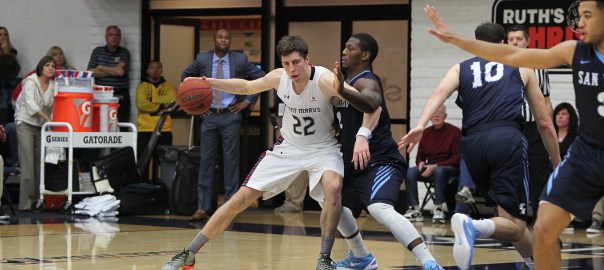
Pineau in the paint.

Showdown in Moraga

The first time Saint Mary’s beat Gonzaga in the Randy Bennett era was on Jan. 8, 2005, the famous “Marigney game” which saw former McClymonds star Paul Marigney explode for 30 points behind seven three-pointers.

That Zags team was ranked 11th nationally and boasted stars such as Adam Morrison, Ronny Turiaf, Derek Raivio and J.P. Bautista. In defeating them 89-81, the Gaels backed up Marigney with Daniel Kickert, E.J. Rowland, Frederick Adjiwanou and Jason Walberg. That group was good enough to earn an at-large NCAA bid just four years after Bennett inherited a dispirited and disrespected 2-27 team.

It took the Gaels another two years, ’till Jan. 15, 2007, to do it again, 80-75 behind Diamon Simpson’s 29 points. Perhaps the most memorable moment that night was a dunk over Zag center Josh Heytvelt by a shaggy-haired redshirt freshman named Omar Samhan, who contributed 20 points. Showing customary restraint, Samhan celebrated his big play by flipping off the Zag bench, definitely including coach Mark Few, whom Samhan said had angered him by referring to him as “the fat boy.”

The Gaels were on a roll by then, stopping the Zags the following year by 89-85 in overtime when they were ranked 25th in the nation and Gonzaga was unranked. That was Todd Golden’s moment in the sunshine, as he canned six-of-six three-pointers, including one in overtime, to score 19 points. Almost overlooked in the glare of Golden’s performance was a 23-point effort by Patty Mills.

Mills went down the next year during a game in Spokane when the Gaels seemed poised to extend the winning streak to the Zags’ home court. After Mills departed for the NBA before the 09-10 season, the Gaels faltered in both regular-season contests. They rediscovered their mojo in the WCC tournament, routing the Zags 81-62 in the championship game and rolling into the NCAA tournament.

Following a Sweet Sixteen appearance to cap the 09-10 season, the Gaels took the rivalry to the next level by defeating Gonzaga in Spokane, 73-71, on Jan. 27, 2011, behind Mickey McConnell’s 27 points.  When the Gaels defeated the Zags 83-62 the following January in Moraga, behind Matthew Dellavedova’s 26 points, they had won three out of five from the Zags. They extended that to four out of six by winning the WCC tournament and an outright WCC championship (they had shared the regular-season title with Gonzaga the year before).

Saint Mary’s lost its momentum against Gonzaga in 2012-13, losing three times and settling for an at-large NCAA bid, where they eventually fell to Memphis in Delly’s last game as a Gael. The next two years (see “Gaels or ‘not Gaels'”) were downers for Bennett’s program, leading them to tomorrow night and a showdown which will help determine whether they are ready to compete head-to-head with the Zags once again.

So here we are

That the Gaels are early 8-to-8.5 point favorites over Gonzaga says a lot about the vicissitudes of college hoops. No one gave any WCC team, least of all Saint Mary’s, a chance to challenge Gonzaga this season, as they returned a dominating front court and a promising back court that had been groomed in the shadow of four-year stars Kevin Pangos and Gary Bell Jr.

But the Zags proved vulnerable early, losing 62-61 in a pre-season tournament to Texas A&M, with Przemek Karnowski in the lineup. Their shortcomings became more pronounced when Karnowski went down with season-ending back surgery, and they lost three more times — at home, no less — in succeeding weeks. The capper was a 69-68 loss to BYU on Jan. 14, giving them a conference loss and dropping them into a tie with Saint Mary’s at 6-1 in the WCC.

The biggest change for Gonzaga since the season began has been increased reliance on center Domantas Sabonis and forward Kyle Wiltjer. With Karnowski the starter in the post, Gonzaga was able to use Sabonis strategically. Although infinitely talented offensively, Sabonis is an indifferent defender and somewhat of a foul magnet. He flourished behind Karnowski, averaging only 23.2 minutes per game but routinely posting double-double numbers.

Since Karnowski’s injury, Sabonis has increased his minutes to 32.8, a 10-minute bump which seems just enough to get him in trouble. The worst case scenario of the new Gonzaga reality was played out in the loss to BYU, when Sabonis picked up fouls early and late that put him on the bench and left the offense almost entirely in the hands of Wiltjer. The wily, 6-10 Wiltjer rose heroically to the occasion, dropping 35 points on BYU before faltering at the free throw line with a chance to tie the game in the final seconds.

In three post-Karnowski losses, Wiltjer and Sabonis have scored 51 against Arizona (out of a total of 63), 38 against UCLA and 40 against BYU, Sabonis contributing only five in that one. Heralded point guard Josh Perkins has only sporadically lived up to his billing, leaving back court mates Eric McClellan and Bryan Alberts to fill roles they don’t seem up to. Another pre-season favorite, Portland prep standout Silas Melson, has been parked in Few’s doghouse.

Gaels’ opportunity

Saint Mary’s season has been the flip-side of Gonzaga’s, with a little-known crew leading the nation in field goal percentage and placing near the top in three-point shooting, assist-to-turnover ratio and defensive efficiency. Differing from the sometimes-scattered performances of the past two seasons, this year’s Gaels have shown a steadiness of purpose, team cohesiveness and commitment to defense that have led them to a 15-2 record.

Moreover, the Gaels’ strengths position them to do well against the Zags. Bennett has insisted on sharing the post position between Dane Pineau and Jock Landale, even though both have shown flashes of being able to take over sole occupation of the pivotal spot. Pineau battled Cal freshman sensation Ivan Rabb even in a heart-breaking loss to the Bears, grabbing 15 rebounds and scoring 10 points against the taller player. Landale won WCC Player of the Week honors for his 24-point performance in last week’s win over Pacific, going 7-7 from the floor and sinking 10-12 free throws.

Thus, Saint Mary’s has two big bodies to throw at Sabonis, which may force Few’s hand and bring redshirt freshman Ryan Edwards onto the floor more than usual. Advantage Saint Mary’s.

To try and slow down Wiltjer — stopping him is a pipe dream — Bennett will call on redshirt freshman Evan Fitzner and true freshman Kyle Clark. Fitzner will be one of Wiltjer’s few opposite numbers who can match his size, if not his offensive virtuosity. At 6-10 and boasting an excellent three-point stroke, Fitzner needs only to harken back to his stellar performance against Cal to draw inspiration for the Gonzaga contest.

Clark is a wild card because he has shown considerable promise at times, while fading at others. At around 6-6, he is smaller than Wiltjer but plays aggressive defense and will get right in the Zag leader’s face. He also has active hands and often swats the ball away from opposing players. Perhaps more importantly, Clark, too, is an excellent three-point shooter, so Wiltjer will have to move out of the paint to guard him just as he will Fitzner. The Gaels don’t need an advantage here, just a stalemate.

If Gael fans feel any superiority over Gonzaga it is in the back court, where Joe Rahon and Emmett Naar have been everything that Perkins et al have failed to become. Naar leads the Gaels in scoring, but the closeness among four starters averaging double figures is so pronounced it makes that statistic almost irrelevant. Besides, it is Naar’s play-making ability more than his sometimes sizzling three-point shooting that makes him dangerous to the opposition. As a second point guard on the floor with Rahon, Naar greases the smooth-flowing Gael offense to an extent that most college guards only dream about.

Rahon is the Gaels’ gutty leader, displaying a calm that was forged as point guard for two years at Boston College in the ACC before transferring to Saint Mary’s. Unflappable is the best word to describe Rahon, but he can also score in bunches and, like Naar, feed the post with great efficiency. Naar and Rahon are a powerful one-two punch that the Zags simply have not delivered this year.

The Gaels have faced three season-making challenges this year — against Stanford and UC Irvine at home and against Cal in Berkeley — and have risen to the challenge each time. Although they didn’t come away from Cal with a victory, they played well against a team with three potential NBA players in its lineup. Gonzaga is the fourth gut-check of the season, and Saint Mary’s is in excellent position pass that one Thursday night in Moraga.

I’m counting on it.

Dane Pineau, shown working in the paint earlier this year against San Diego, will be a key factor in the Gaels’ challenge to Gonzaga. Photo courtesy of Tod Fierner.

Bench support

Crunch time is a-comin’

The Gaels woke up on this fine January morning and smiled at what their WCC brethren had wrought over the Thursday-Saturday weekend: BYU knocked off Gonzaga 69-68 in Spokane, giving the Zags an unheard-of third home loss. More importantly, it evened the Gonzaga-Saint Mary’s conference loss record at one each, bringing them into a tie for first place at 6-1 (following the Zags’ ritual destruction of San Diego by 88-52).

As if that weren’t enough collegial cooperation, the spunky Portland Pilots dropped BYU 84-81 following the Cougs’ inspiring — and apparently depleting — upset of Gonzaga. That gave BYU its second conference loss and produced a nice break between the Gaels and Cougs. As of today, the top half of the conference looks like this:

Saint Mary’s                 6-1 (15-2)

Gonzaga                         6-1 (14-4)

BYU                                  4-2 (13-6)

Pepperdine                     4-3 (11-7)

Pacific/Portland             3-4  (5-12, 9-11)

This is a nice position for the Gaels, but what the basketball gods give they are also prepared to take away. Thus, this week’s home contests with the ever-formidable Zags and the unpredictable Pilots present a crucial test for Saint Mary’s. Sweep both and gain a one-game advantage over Gonzaga heading into the second half of the conference; lose one or both and fall a game or more behind.

Schedule gets tougher

If that were not enough of a challenge, the WCC schedule grows considerably more difficult in February. The Gaels will play six of their next nine games on the road, including two back-breaking combinations — the Feb. 4-6 swing through BYU-San Diego and the Feb. 18-20 Northwest Passage against Gonzaga and Portland.

Clearly, making WCC hay while the sun shines in Moraga (briefly, through the raindrops) is imperative. Are the young, over-performing Gaels ready to seize their destiny? As the inimitable Warner Wolf famously proclaimed, “Let’s go to the tape!”

Okay, let’s go to the stats since no one has made a tape of the season thus far. Statistically, the Gaels are fine. They lead the nation in field goal percentage at .534 and are among the leaders in three-point shooting accuracy at .447. They boast an enviable assist-to-turnover ratio of roughly 2-to-1, and the guard tandem of Joe Rahon and Emmett Naar average 6.8 and 6.4 assists per game, respectively.

The Gaels have four players averaging double-digit points per game — Naar 13.8, Dane Pineau 11.1, Calvin Hermanson 10.6 and Jock Landale 10.4. Rahon lurks just outside the double-digit range at 9.5 PPG, and one assumes could easily join the club if he chose to shoot more. Similarly, starter Evan Fitzner at 8.5 PPG is in range of double digits with considerably fewer minutes played than anyone except Landale.

Landale, of course, is not a starter, so the best way to look at his production is in combination with the person with whom he shares the post position — Pineau. Together, the Pineau-Landale contribution in the post is 21.5 PPG.

Randy Bennett has crafted an efficient, unselfish offensive machine out of the bits and pieces left over from last season. Although the construction of this year’s team was not as haphazard as most Gael observers assume — Bennett had been carefully cultivating Pineau, Landale, Hermanson and Fitzner  and knew what he had in the transfer, Rahon — it is, nonetheless, a monument to his team-building ability.

Even more impressively, if overlooked, is the defensive tenacity of the Gaels. Until Pacific broke the 60-point barrier in last week’s 78-62 loss, Saint Mary’s had been routinely holding opponents around 60 PPG. The Gael key, actually, is team field goal percentage, and they strive mightily to hold opponents under 40%. Pacific, again, broke that barrier with 42% shooting, so Bennett has a clear objective in this week’s practices — restore the defensive spine of his team before taking on free-wheeling offensive squads in Gonzaga and Portland.

Okay, so it’s not Monmouth quality yet, but Gael bench-sitters Ben Sheets, Tanner Krebs and Jordan Hunter do their best to support the team. Photo courtesy of Tod Fierner.


Naar, Rahon are back, but where’s our 4?

First, let’s concentrate on the symphony of destruction conducted by Saint Mary’s guards Joe Rahon and Emmett Naar in the Gaels’ 78-62 dismantling of Pacific Thursday night.

It was simply no contest, as the Pacific guards assigned to Rahon and Naar, T.J. Wallace and Alec Kobre, had seemingly never watched tape of the Gael back court. On the Gaels’ first possession, Rahon used his hesitation dribble to blow by Wallace and make an easy lay-up.

Naar, coming off a sub-par performance in the Gaels’ loss to Pepperdine last week, was equally aggressive. With Kobre playing far off him for reasons only he can explain, Naar buried a three on the Gaels’ next possession. With fear of penetration firmly established, Rahon moved toward the bucket next time down and lobbed a pass over the Pacific front court defender who left his man, Dane Pineau. Pineau easily converted the lob for another lay-up.

Then, Naar simply dribbled past Kobre for a lightly-contested runner. The Gaels had scored nine straight points in less than three minutes, went up by 9-2, and essentially settled the matter. They finished the half shooting 83% (15-18), Naar and Landale scored 15 points each and Saint Mary’s went to the locker room leading 46-27.

Naar, whose perch at the top of the nation’s three-point shooters was upset by consecutive low-scoring games, bounced back with a 7-11 night, including 4-4 on threes, and totaled 21 points. Landale topped that, going 7-7 from the floor and 10-12 from the free throw line for a tidy  24 points. Rahon settled for eight points and seven assists.

True, the Gaels slowed down in the second half, scoring only 32 points on 42% shooting, but the overall FG percentage of 59.5 should be enough to keep them on top of the NCAA. They earned that spot with a 53% average coming into the game, so unless some other team shoots 75% or so over the weekend, the Gaels should continue leading the nation.

What’s up with Fitzner?

Gael fans would have thought redshirt freshman forward Evan Fitzner suffered enough chagrin with a woeful performance against Pepperdine — no points, two rebounds and four fouls,  plus a major contribution to Pepperdine forward Jett Raines’ 24-point barrage. Not so fast there, karma believers. Fitzner handcuffed himself with thee first-half fouls that limited his playing time against Pacific to 12 minutes, scored a single bucket while missing on two three-point attempts and pulled down just three rebounds (Naar had five).

His slump is concerning considering who is rolling into McKeon Pavilion next Thursday as the Gaels battle Gonzaga for WCC leadership. Zag forward Kyle Wiltjer is scoring crazy numbers, 35 in Thursday’s loss to BYU, and presents a major headache for the Gaels. Saint Mary’s desperately needs the Fitzner who bagged three three-pointers in the first five minutes of the second half against Cal and who scored 13 points in the win over BYU. Fitzner needs it, too.

Partially because of Fitzner’s foul problems, the Gaels used Pineau at the four with Landale in the post for long segments against Pacific. That worked out fine for Landale, who feasted on the assist-making prowess of Naar and Rahon for a monster night, but it gave the Gaels little firepower at the four. Pineau scored seven points in the post, but balked at attempting any three-pointers when substituting for Fitzner.

The Gaels will be much better off against Gonzaga if Pineau and Landale can share the post position, guaranteeing a fresh body on the Zags’ dominating center, Domantas Sabonis. That puts the onus on Fitzner to guard Wiltjer without fouling (too much), and to knock down threes to loosen up the post area. Fitzner’s record of coming up big in the Gaels’ two biggest games this year — Cal and BYU — suggests he will rise to the occasion  against Gonzaga.

Referees revenge

To be fair, close analysis of the Pacific game indicates Fitzner was as much sinned against as sinning. I noted five phantom first-half fouls called by the whistle-happy crew officiating the Pacific game (44 fouls in 40 minutes) — three against Fitzner. He had barely started the game when he fought for position against Pacific’s rugged power forward Tonko Vuko. Careful study of the television broadcast showed only the slightest contact, but the whistle went off with 30 seconds gone.

A few minutes later Fitzner was the victim of the ubiquitous moving screen violation, certainly the most over-used of the “freedom of movement” fouls referees are obsessed with this season. Fitzner barely moved as he attempted to establish a high pick-and-roll position, but the whistle nevertheless sounded. That earned Fitzner a place on the bench, but the cruelest blow came a little later in the half when he went back in because Pineau picked up his second foul on another moving screen call.

Contesting Pacific’s seven-foot Sami Eleraky, Fitzner looked like a model in a Proper Defense video — standing stock still with both arms raised straight to the sky. Whistle, three fouls, banishment to the bench. In Fitzner’s favor, his demeanor after a third straight ticky-tack foul was upbeat. He parked himself next to Pineau and engaged in a conversation that must have contained elements of “What’s a guy gotta do to avoid a foul these days?”

Sketchy officiating aside, the Gaels need major contributions from all their big guns if they are to capitalize on the favorable position they are in after BYU beat the Zags. By suffering their third home loss of the year — something that used to happen as often as Donald Trump tells the truth — Gonzaga took Saint Mary’s off the hook for the Pepperdine loss. The Gaels need to hold their home court to give Gonzaga a second league loss and inoculate themselves against potential road losses in Spokane and Provo.

They also need the win for insurance against NCAA selection committee qualms about their strength of schedule. Wins over BYU and Gonzaga are absolutely necessary to get the Gaels into the Dance, and that fact is assuredly not lost on the Saint Mary’s brain trust. Once again the schedule is the Gaels’ friend, as they have a full week to prepare for the Zag invasion. Coach Randy Bennett was feeling so generous after Thursday night’s win that he said he might give  his charges a small practice break, but I would expect a major effort before next Thursday’s nationally-televised showdown.

Lessons from the road

I’m envisioning Pepperdine coach Marty Wilson watching a replay of Thursday night’s Saint Mary’s-Loyola Marymount game and experiencing a light bulb moment: the Gaels look vulnerable defensivly on their front line. As the Lions’ Adom Jacko went through Gael defenders Jock Landale and Dane Pineau for nine out of 11 buckets, Wilson might have added another thought: I’ve got two Jacko-like players on my team, and they might be able to do some serious damage.

Whether Wilson actually spent time before a W.tv rerun of the Gaels-Lions game or was inspired by scouting or coaching genius, he had a solid game plan for Saturday’s showdown between his Waves and Randy Bennett’s Gaels. Reduced to its simplest terms, it called for unleashing a steady diet of Stacy Davis and Jett Raines on Landale, Pineau, Evan Fitzner and Kyle Clark.

None of those front line Gael defenders were particularly effective in slowing down Davis and Raines, as they combined for 13 of 24 buckets and a stunning 41 points. Landale and Pineau, who had outscored every post tandem they faced before Saturday, produced 32 points of their own. Not too shabby, but not nearly good enough when you can’t stop the other guys.

Perhaps the most surprising thing about the Davis-Raines outburst was how predictable it was. These two have been around Malibu for four years now, making this the seventh time the Gaels have faced them. Davis has been brilliant ever since he stepped foot on the Pepperdine campus, and will probably end his career as the Waves’ all-time leading scorer.

Raines has been less productive than Davis, but hardly a lightweight. Moreover, he has specialized in the role he played Saturday, as a  quicker, more elusive option than Davis, who would rather pound it inside despite his undersized 6-6 or so frame.

You would have thought the Gaels had never heard of either of them, much less played against them. Thinking of the relative inexperience of the Gael foursome — a junior, a sophomore and two freshmen — that’s not far from the truth. The veteran-rookie match-up was most pronounced when Fitzner was isolated on Raines — Raines schooled Fitzner mercilessly, leading to an early bench appointment for the Gael forward and a lamentable line of zero points, two rebounds and four fouls in nine minutes of play. Ouch!

Other culprits

The front line was not alone in shouldering blame for the Waves’ upset win. Remember the fearsome Gael back court of Emmett Naar and Joe Rahon? Watching those two listlessly go up and down the court I would have entertained a finding of flu, mononucleosis or bubonic plague as a reason for their lackluster play.

They combined for 15 points on 5-15 shooting, including an anemic 2-6 on three-pointers. Naar, the former national NCAA leader in three-point accuracy, went one-for-one from distance, but took only six shots in all. That’s not nearly enough, and given Naar’s similar disappearance against Cal — the Gaels’ other loss this season — raises a red flag in the leadership department. Leaders lead, they don’t shirk when the going gets tough. As for Rahon, he looked like the game plan didn’t interest him — it certainly didn’t include him — and seemed to be playing out the clock.

Contrast the Naar-Rahon output with that of Calvin Hermanson, who almost donned a hero’s mantle despite his team’s overall poor play. Hermanson sank a three-pointer with about 12 seconds left to pull the Gaels within one, then got a chance to send the game into overtime a few seconds later after the Waves sank two free throws.

Despite everyone on the Pepperdine roster thinking that Hermanson was the likely shooter, the Gaels executed nicely and got him the ball with enough time to shoot. He calmly ball-faked his defender to get free, then measured the tying shot. It rimmed out, but it was a good effort.

The point is, Hermanson attempted 11 three-pointers on Saturday. He made only four, which isn’t a spectacular result (36%), but he was willing to make the effort. Naar’s ineffectiveness cried out for Bennett to bench him, particularly with such a dynamic shooter as Stefan Gonzalez sitting next to him. But Bennett is ferociously loyal to his starting guard tandem and is loathe to yank either of them. Perhaps more playing time for Gonzalez in relief of Naar instead of Hermanson — who is getting less and less easy to replace — will be one result to come from Saturday’s disappointment.

The future

None of the ills on display Saturday are irreversible, and one can envision a few strenuous practices in the run-up to a Thursday encounter with Pacific. It will likely be a healthy diet of Basketball Fundamentals — defending without fouling (Raines and Davis made 14 out of 15 free throws), blocking out, rebounding, etc.

As for Naar, it is difficult to envision a return to the late-season funk that engulfed him last year. He is so much improved this year, his attitude has been so positive, fans can probably call the Pepperdine effort a one-time stumble. A loud, friendly home crowd will replace the eerily quiet witnesses at LMU and Pepperdine, and the offense will no doubt return to its multifaceted glory.

Pineau and Landale should not be marked by their difficulties, either. Both played like warriors against Pepperdine, and Landale suffered a half-season’s worth of rim-outs. Neither of them lacks resolve or a desire to improve, and it should be fun to watch them against a weak Pacific squad.

Most importantly, the Gaels’ lofty hopes for a memorable season are still intact despite the Malibu malaise. Saint Mary’s will have a week’s preparation following the Pacific game to get ready for Gonzaga, and that is when decisions will be made about redemption, post-season chances and WCC supremacy.

On the road again…

Loyola Marymount’s Adom Jacko put up a good fight against Saint Mary’s Thursday night. Unfortunately, none of his Lion teammates matched his enthusiasm so LMU fell to the Gaels 73-48.

Jacko wasted no time announcing his presence, blocking Calvin Hermanson’s attempted three-pointer just 45 seconds into the game. That was one of two blocks credited to him, although Gael fans screamed that the second was actually a goal tend on a Hermanson driving lay-up.

Nevertheless, the chiseled, 6-8 Jacko, his dreads falling midway to his shoulders, totaled 21 points on 9-11 shooting, sank all three free throws awarded him, pulled down eight rebounds and got a steal on top of his two blocks. The steal was a thing of beauty, as Jacko figured out a way to stop the Gaels patented pick-and-roll offense — jump high and intercept the intended lob before it gets to the cutter.

He presented more problems for the Gaels than any other post man, or men, they have faced this year, and it is an interesting question why. Is Jacko a true phenomenon, a muscular, quick-jumping dervish with a nice touch out to 10 feet, or were Gael bigs Jock Landale and Dane Pineau a step slow?

You could make a case either way, as Landale and Pineau did seem to be back on their heels against Jacko. They never bodied him as they have done successfully to a host of talented big men this year, always jumping to defend his shot just after he released it. It didn’t work.

Regardless of the answer to that question, no one else on Mike Dunlap’s revised roster was too involved in the proceedings. Take away Jacko’s 21 points and it leaves just 27 for the other 10 Lions who made it to the floor — an average contribution of 2.7 points. The Gaels’ overall defense was excellent, holding LMU to 36% shooting and keeping the opposition score below 50 points for the second straight game (San Diego managed 46). It is hard to determine who among the Lions is going to help them rise too far out of the WCC cellar.

Offensively speaking

The LMU game was not a model of efficiency as the preceding tussle with San Diego was. After a sluggish first half, the Gaels bounced back with a better second-half effort but didn’t come close to the 60% field goal shooting they managed against San Diego. Maybe that’s the price of playing in a new environment after enjoying 11 home games out of thirteen before heading to West LA. It did not seem to be a crippling weakness, as Randy Bennett’s team seems to realize that defense is the heart of their identity.

Pineau and Landale fell to a combined 20 points and 10 rebounds after successive games of 28 and 11, but their individual stats were fine. Landale was 4-5 from the field and sank all four free throws to total 12 points, and Pineau went 4-8 and totaled 8. After seeming to get on top of his free throw stroke in earlier games, Pineau bricked two attempts Thursday night. That is something he will have to work on continually to remain consistent, while Landale’s free throw shooting might be made into an instructional video.

Emmett Naar may be emerging from his four-game three-point funk, as he made two of five from distance. That’s the first time he sank more than one three-pointer since going one-for-six against Cal. Naar seems to realize that the only way to get back to his blistering early pace is to keep shooting, and he was determined to make multiple attempts against the Lions. He kept up his excellent play in the lane, making two of three lay-ups to lead the Gaels in scoring with 15 points.

Hermanson chipped in 12 points of his own, including two more power drives to the hoop. He was denied perhaps his most elegant effort by a Jacko block, although it did seem to court-side eyes that the ball was nearly inside the cylinder before Jacko arrived to swat it away. That aside, Hermanson needs to keep being aggressive in the paint, as it complements his three-point shooting and makes him considerably more dangerous.

The southern California road trip continues Saturday with a matinee engagement in Malibu against Pepperdine, the Team Who Would Be Master of the Gaels. If Bennett’s team was a little off against LMU — perhaps the residue of a weak opponent and a lifeless environment — the prospect of playing the Waves should enliven them.

Most outside experts picked Pepperdine to finish higher in the WCC than the Gaels, and that fact did not go unnoticed in Moraga. Notwithstanding that pre-season praise, Pepperdine has underwhelmed so far this year, barely squeaking by a weak Pacific squad 81-76 on their home court Thursday night.

The Gaels topped the Waves in Malibu last year, and will be extremely interested in repeating that effort Saturday afternoon. I wouldn’t bet against it.

Jacko photo

Something old, something new

Saint Mary’s College, the WCC’s stay-at-home champs for 2015-16, take flight this weekend (Thursday-Saturday) for their first road trip of the season (no, a bus trip down I-680 to Santa Clara or a jaunt through the Caldecott Tunnel to Berkeley don’t count).

This will involve an airplane ride, a hotel stay and food from a source other than Oliver Hall. Traumatic for the young Gaels? I don’t think so, mostly because of the caliber of competition awaiting in Loyola Marymount and Pepperdine.

Loyola, competing under the hand of Mike Dunlap for the second year, and Pepperdine, guided by Marty Wilson, just don’t scare anybody.

The Lions of Loyola stumbled through an 8-23 season last year as Dunlap rolled in and pronounced almost all that had been there before him  unacceptable. Even the excellent Evan Payne, who seemed likely to surpass Anthony Ireland as one of LMU’s all-time great guards, didn’t meet Dunlap’s standards. He was first benched, then transferred.

Dunlap was given a pass for that first year, as he had a charter to get his own team in place before any judgments were rendered. With eight new players coming in and a redshirt becoming eligible, now is the time for Dunlap to prove himself. Standing at 7-7 overall and 0-3 in WCC play, the results have been mixed, to be charitable.

Dunlap has assembled a group of foreigners (Australia, Canada, Czech Republic, Egypt), JC transfers (7) and new recruits (3) to try and change a culture that seems frozen in 1990 and the wondrous run of Bo Kimble and Hank Gathers. So far they haven’t beaten anybody of note, and it’s not clear Dunlap will prove more successful than the beleaguered Max Good or a host of previous LMU coaches.

Of the new faces, three players show promise: 6-8 forward Adom (pronounced “autumn”) Jacko, 5-11 point guard Brandon Brown and 6-6 swing man Steven Haney. Jacko is making a case for Newcomer of the Year with averages of 14.2 PPG and 6.4 RPG. He is the kind of rugged paint presence that a good program needs, and the Lion faithful are rooting for him to succeed as league play continues.

Another need for a rebuilding team is a solid point guard, and the  Lions seem to have found one in Brandon Brown, who was a juco all-American at Phoenix College in Laveen, AZ. It also doesn’t hurt to have a knockdown jump-shooter, and redshirt sophomore Steven Haney, a JC transfer from Central Florida, is pegged to fill that role.

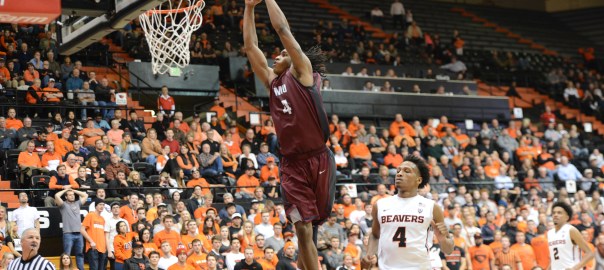
In the photo above, courtesy of the Loyola Marymount Athletic Department, LMU power forward Adom Jacko stuffs against Oregon State back in December.

That’s a good foundation, and LMU was having some success, winning six out of eight before the WCC season kicked off. There followed a disastrous trip to Gonzaga and Portland, both blowout losses, and a short ride down the Pacific Coast Highway to Malibu, where Pepperdine defeated them in overtime 68-65.

In its favor awaiting the Gaels’ arrival is the fact LMU has played only two home games since late November. Settling back in to Gersten Pavilion might revive the Lions’ early-season optimism. Then again, Saint Mary’s has won nine straight times on that same floor.

What’s up with the Waves?

Pepperdine was something of a media darling before the season began, boasting a squad returning intact from an 18-13 record and fourth-place WCC finish. That fact, compared with Saint Mary’s having graduated its entire starting five and having no players anyone could recognize, prompted WCC coaches and several pundits to elevate the Waves over the Gaels in pre-season predictions.

It hasn’t happened, as the Waves joined LMU in ignominy on the Gonzaga-Portland trip and barely scraped by the Lions at home last week. Pepperdine stands at 8-6, 1-2 in conference, and ponders many questions. The most pressing is how to restore its stellar guard play behind last year’s triumvirate of Jeremy Major, Amadi Udenyi and Shawn Olden.

Major is back better than ever, but Udenyi is proving slow to recover from a ruptured Achilles tendon suffered near the end of last season (3.4 PPG on 21 minutes per game). Even worse, Olden, who averaged an excellent 9 PPG in earning all-freshman WCC honors, has shut it down for this season to undergo surgery on a banged-up ankle. Suddenly the back court is a problem instead of a strength for the Waves.

That puts Pepperdine’s strength right back where it’s been for the last three years, in the hands of all-everything forward Stacy Davis. Davis, the undersized but never over-matched power forward, is on a pace to become Pepperdine’s all-time leading scorer. Aided by the cagey Jett Raines, the elusive Lamond Murray Jr. and outstanding freshman Kameron Edwards, Davis can still wreak some havoc in the WCC.

The Gaels at 13-1 (4-0 in the WCC), are starting to attract some national attention. Stanford’s victory over then-no.21 Utah last week prompted some observers to posit that the Gaels’ 17-point domination of the Cardinal back in November might have been worth something after all.

In addition, Saint Mary’s leads the nation (not just the WCC) in three offensive categories — assist-to-turnover ratio, field goal percentage and three-point field goal percentage — and is in the top 16 in 11 others. As the college season nears its halfway point, those numbers are beginning to look pretty impressive.

In a season of clearing hurdles, winning on the road is one item on the checklist that the Gaels have yet to strike off. A strong weekend in southern California would do much to rectify that situation.

Pineau in the paint.

Routine is good, dominating is better

The overriding question on Gael fans’ minds as they strolled out of McKeon Pavilion Saturday night following their team’s 79-46 romp over San Diego was, “How did these guys beat San Diego State?”

Good question, because it certainly didn’t appear Lamont Smith’s charges were capable of beating even a so-so San Diego State. But records exist saying they did, indeed, pull off the upset, 53-48, on Dec. 6 in a baseball park, Petco Stadium. Granted SD State is struggling through a 9-6 season, with losses to Arkansas-Little Rock and Grand Canyon, among others, but still…

There was a tiny  bit of frisson before the tip-off, generated by the anticipation of Smith facing off against his old mentor, Randy Bennett. Smith was one of Bennett’s earliest hires after Bennett came to Moraga in 2000, and he has compiled a commendable record while working through the college ranks — Santa Clara, Arizona State, Washington, New Mexico — to assume his first head coaching slot at USD at age 39.

And there was a history of grinding wins — and gut-wrenching losses — when San Diego was guided by Bill Grier, Smith’s predecessor. Would San Diego work its voodoo on the Gaels one more time?

Not a chance.

It appeared the Gaels were on their way to a routine win, and, most fans would agree, routine is good when you’re building a resume for a possible post-season run. Saint Mary’s had already notched a notable victory by throttling BYU 85-74 Thursday night, so a routine victory over San Diego would not ruffle any feathers.

But Bennett’s boys were having none of that “routine” stuff, and came out of halftime smoking. A good first half of shooting 50% from the floor and 60% from three-point range, which gave them a 34-21 lead,  accelerated to 67% overall, and, in a mild decline, 58.2% on threes in the second, as Stefan Gonzalez (4-5, all threes), Dane Pineau (8-9), Calvin Hermanson (4-7) and Jock Landale (5-9) stepped up their games.

That 34-21 lead zoomed to a 37-point bulge with 6:20 left, and Bennett sent in the reserves led by Franklin Porter, Jordan Hunter and walk-on Jack Biebel.

Some highlights

For the second game in a row, the Pineau-Landale duet in the post combined for 28 points on a combined 13-18 shooting. They also grabbed 11 rebounds between them. These two seem to be trying to outdo each other, creating a fascinating tableau of post play: Pineau is quicker on his feet than Landale, while Landale is perfecting the power game enshrined at SMC by Omar Samhan and Brad Waldow. They both successfully navigated the shot-blocking machine that is San Diego’s Jito Kok, who leads the WCC in swatting away attempts and had nine blocks in the Toreros’ win over UC Davis. Kok had only two blocks against the Gaels, a number that was matched by Pineau.

In the photo above by Gaels’ photographer Tod Fierner, Pineau works his way toward one of his eight buckets (on nine attempts).

The Gaels’ back court of Joe Rahon and Emmett Naar scored only 14 points between them, but each dished out seven assists to guarantee Saint Mary’s will continue its top-10 national ranking in that department. Someone should be compiling a highlight reel of the play-making exploits of these two, as they contribute several beautiful dishes each game. Naar specializes in a dazzling crossover dribble that freezes his opponent and leads him either to a driving bucket or a deadly assist.

And, hopefully, someone is chronicling the rise of Calvin Hermanson from  occasional three-point threat to stud small forward. Hermanson sank only one three-pointer against San Diego following a five-for-seven three-point outburst against BYU, but his power drives to the hoop accounted for the rest of his 11 points. He combines strength and quickness as he attacks the basket, and has great finesse around the rim.

Remember former Gael standout Ian O’Leary? He would frequently break down a defense by taking the ball hard to the basket, only to watch it inexplicably rim out, or fall short, or otherwise miss the mark. Not so with Hermanson. If he gets close to the bucket he is going to finish, and that gives the Gaels another weapon to complement their inside-outside game.

Which leads to…

The Gaels under Bennett have done an excellent job of “taking it one game at a time” this season, but that doesn’t mean I have to. As Gonzaga continued its Perils of Pauline trip to the Bay Area Saturday by taking San Francisco to overtime before winning 102-94, comparisons are unavoidable. The Zags also struggled against Santa Clara on Thursday before eking out a 79-77 win, and Saint Mary’s breezed by  both of those teams with 22-point victories. Granted, the San Francisco win was in Moraga and the trip to Santa Clara isn’t exactly a back-breaker, but you’ve got to wonder what’s going on with Mark Few’s boys.

Saint Mary’s moved to 13-1 with the win over San Diego, and has three more games before a Jan. 21 showdown with Gonzaga in Moraga. Assuming the Gaels keep winning over Loyola Marymount, Pepperdine and Pacific, they could face Gonzaga at 16-1. That record is similar to the 18-1 mark the Gaels carried into Spokane in January, 2009, along with the nation’s longest winning streak of 15 straight and a national ranking of 18 or 22 depending on which poll you prefer.

That juggernaut derailed with the broken wrist incurred by Patty Mills as he neared the end of an epic first-half against the Zags (18 points). The Gaels lost the game, lost Mills and, eventually lost out on an NCAA bid to thwart what seemed like an historic season. It is not tempting the gods to think the Gaels will avert a similar disaster this year, and might be in a position to finish what began so promisingly in 2008-09.

Or is it?

In defense of…Dee-Fence!

Following a night in which Saint Mary’s shot 56.4% from the floor in defeating BYU 85-74 and San Francisco scored 107 points — in regulation! — to squeeze by Portland 107-95, it seems, well, quaint, to talk about defense.

But it was the Gaels’ collective defense that throttled the Boys from Provo in a pleasant New Year’s Eve exercise in Moraga. BYU is guard-driven, which is to say, it is front court-challenged. For most games, that works out well for the Cougars because the trio of Kyle Collinsworth, Chase Fischer and Nick (Sucker Punch) Emery averages nearly 50 points per game.

Until last night, when Gael guards Joe Rahon and Emmett Naar, aided by wing man Calvin Hermanson, held them to 16 for 47. That worked out to 40 points on 34% shooting, a total that is skewed by Fischer’s heroic 21 points (he is really good). Emery and Collinsworth were hogtied — Emery 4-14 for 11 points and Collinsworth 4-15 for eight points — by Hermanson and Rahon.

Rahon’s job was perhaps more impressive because Collinsworth is a master at insinuating himself into the paint and scoring on a variety of moves around the basket. Emery is just a chucker, and Hermanson bothered him  enough to keep him from doing major damage.  But what Rahon did was brilliant, and indicates what a student of the game he is and how valuable his defense is for the Gaels.

Rahon, who gave away several inches to the 6-5 Collinsworth, widened his base and denied Collinsworth entry to the paint. Several times Collinsworth put on a couple of moves that usually free him to crash the basket, only to look up and see the extended frame of Rahon right in front of him. Bewildered, he passed the ball to someone else or made ill-fated attempts to score over Rahon.

Rahon draws the opponent’s toughest guard in every game, and provides maximum defense every time. And he gets tougher if his opposite number achieves some early success. In the Gaels’ early-season win over Manhattan, the Jaspers’ best player was guard Shane Richards, who was red hot in the first half, scoring 17 points, including three three-pointers. Rahon was fuming at half’s end, slamming down the basketball after one possession.

He got his revenge in the second half, holding Richards to free throws only. Similarly, in the Gaels’ recent win over Santa Clara, the Broncos’ gifted guard Jared Brownridge — who is capable of 40 points or more — seemed on the verge of a  big night. He scored 11 in the first half, including an improbable three-pointer with Rahon seemingly inside his jersey. Rahon held Brownridge to two lay-ups in the second half.

Kudos to Hermanson

All this is not to say the Gaels were lacking offensively against BYU. Behind that 56.4% shooting — which exceeded their first-in-the-nation average of around 54% — were five players in double figures. The Gaels’ two-man post tandem of Jock Landale and Dane Pineau totaled 28 points on 11 of 13 shooting. Evan Fitzner shook off his sleepwalking performance against Utah Valley (0 points in 14 minutes) to score 13 points on 4 for 8 shooting.

But it was the goggle-clad Hermanson, the former prep sensation from Lake Oswego, OR, who warmed he hearts of Gael fans more than anyone else. Hermanson was on fire in the second half, when he scored the bulk of his five three-pointers (out of seven attempts) en route to a 21-point effort. Hermanson occasionally gets into a zone where he can’t envision the ball going anywhere but the bottom of the net. He was in that zone last night, and the Gaels hope he stays there for a while.

Up next

San Diego comes to Moraga Saturday night, dragging a 5-7 record with it, including a 77-75 loss to  infraction-hobbled Pacific on Thursday. But more than the Toreros’ record will be the center of attention, as its first-year head coach, Lamont Smith, is the first leaf of the Randy Bennett coaching tree to go head-to-head with its old boss (the others: Kyle Smith, Columbia, Eran Ganot, Hawaii, Rick Croy, California Baptist, and Jim Shaw, Western Oregon).

Smith, a former standout at San Diego, was a graduate assistant at St. Louis University under Lorenzo Romar, as was a young assistant coach named Bennett. When Bennett landed the job at Saint Mary’s, Smith was one of his first hires, staying with the Gaels from 2001-07. He moved on to Santa Clara, Arizona State, University of Washington (reunited with Romar) and, most recently was associate head  coach at New Mexico.

Smith was voted San Diego’s best defender in two of his years there, and helped establish the Saint Mary’s pattern of rock-ribbed defense in his time with the Gaels. You can expect his team to reflect that gritty persona, and for his players to give it their all to spring an improbable upset over their coach’s former team.

Despite the WCC-opening loss to Pacific in Stockton, San Diego was showing signs of improvement under Smith, going 4-2 in December and boasting a 53-48 win over San Diego State in a game played at a baseball stadium, Petco Park. It is not true that Smith requested that Saturday night’s game be played in Saint Mary’s Stadium.

Gael fans will notice several familiar faces with the Toreros, including WCC shot-blocking champ, Jito Kok, and hard-nosed wing man Duda Sanadze. But their eyes will probably focus on San Diego’s back court, where four-year nemeses Johnny Dee and Christopher Anderson have departed along with coach Bill Grier (the players graduated, Grier was fired).

Smith has called on sophomore Marcus Harris, who played in all 31 Toreros’ games last year, and newcomer Olin Carter III to fill the holes left by Dee and Anderson, although another holdover, sophomore Vasa Pusica, is getting more minutes than Sanadze. San Diego is still a guard-oriented team, and the Gaels can be expected to exploit its advantage inside with Pineau, Landale and Fitzner.

Because of the Smith-Bennett element it will not be a routine conference game. If the Gaels are still giddy about defeating BYU, Smith’s charges will probably remind them early that they will need another outstanding effort to get the win.

Jackson photo

Down in the valley

It takes patience to follow a three-point-shooting basketball team because, as Saint Mary’s demonstrated painfully in a 65-50 victory over Utah Valley Monday night, sometimes the shots just don’t fall.

If one were to post the box score from the Utah Valley game side-by-side with the one from the previous game against Santa Clara — and blot out the team names — you would never pick the Gaels as the same team in each. Three-point percentage against Santa Clara, 47.6% (10-21); three-point percentage against Utah Valley, 11.8% (2-17).

Emmett Naar, last week the nationwide statistical leader in three-point shooting at 63%, has made  only one out of eight in his last two games. Showing he is not a one-trick pony, Naar played well against both Santa  Clara and Utah Valley, scoring 21 points with 11 assists in the two games. But he seems to have lost confidence in the long ball.

Evan Fitzner disappeared against Utah Valley after shining in the Santa Clara game with 21 points on 4-5 three-point shooting. He went 0-4 in 14 minutes against Utah Valley, including three three-point attempts that looked like they were hoisted by the guy who tries to win a prize at half-time by making a half-court shot.

Just to complete the roll call of futility, Calvin Hermanson sank his first three-pointer then missed five in a row. Joe Rahon went 0-3 and Kyle Clark 0-2.

Suicide watch?

There are many ways to rationalize the poor performance against Utah Valley: after 11 ultra-efficient games (including the Cal loss), the Gaels were due for a stinker; it was the holiday blahs, the game coming three days after Christmas on a dead campus that fueled depression; the team was looking ahead to Thursday’s huge showdown against BYU and just couldn’t muster an all-out effort against Utah Valley.

Either or all of those might be legitimate, but a good way to think about it is to put it in perspective. Travel back in time to about this date last year. It was Dec. 16 not the 28th, but the opponent was similar — a 3-6 Northern Arizona team that didn’t appear particularly strong. The Gaels lost that game 73-71 despite a 25 and 15 night from Brad Waldow, 15 points from Dane Pineau and 10 each from guards Kerry Carter and Aaron Bright. They crossed the magical 70-point barrier that almost always signals a Gael win to go up 71-69 with 18 seconds left, but lost the game by giving up a lay-up for the tie and then bungling the inbound pass to allow a grateful Northern Arizona to put in the game-winner just before the buzzer.

A stunning loss, one that prompted coach Randy Bennett, who almost never calls out his team, to excoriate the guards for playing lousy defense. The 26 points scored by Quinton Upshur (don’t look for his name on any NBA roster) seemed to rattle the usually-calm Bennett, and it allowed him to scream “poor defense” rather than berate the Alphonse-and-Gaston pratfall by Bright and Carter that allowed the inbound pass to be hijacked.

Utah Valley didn’t score 73 points against the Gaels. Indeed, by limiting the Wolverines to 50 points on 27.4% shooting, Saint Mary’s improved its overall defensive stats. No guard went for 26 against the solid defense of Rahon and Naar, although Jaden Jackson did a fair impression of Tyler Haws’ little brother by dropping 16 on the Gaels.

Utah Valley’s Jaden Jackson did a fair impression of former BYU great Tyler Haws in dropping 16 points on the Gaels despite a 65-50 Saint Mary’s victory. Photo courtesy of Utah Valley University Athletic Department.

In other words, if Utah Valley proves to be the nadir for this year’s team, it is not that badly off.

About BYU

It is hard to overstate the importance of the BYU game. No matter how well they continue to play this year, without victories over BYU and Gonzaga the Gaels will be vulnerable to the whims of the NCAA Selection Committee come tournament time. That committee operates like the admissions board at Harvard — it looks for reasons to keep teams out of the tournament. The biggest failing the committee cites in voting out seemingly worthy teams is lack of big wins — signature wins if you will.

By losing to Cal, the Gaels blew their only chance for a signature non-conference win. That leaves the WCC race and the four games Saint Mary’s has against BYU and Gonzaga to convince a skeptical selection committee that it deserves an NCAA bid. Of those four opportunities, the two home games present the best chance for victory. The Gaels don’t want to blow the first of these chances Thursday night.

BYU has had a solid, if not dominant, non-conference season. At 9-4, with losses to Long Beach State, Utah, Colorado and Harvard, they are polishing an offense missing the invaluable Tyler Haws. Chase Fischer has stepped into the Haws role by averaging 17.4 PPG, buttressed by a 41-point barrage against New Mexico in a 96-66 BYU romp, and 26 points in BYU’s most recent win, 84-76 over Northern Iowa (the improbable conqueror of North Carolina earlier in the season — talk about a signature win).

Fischer is followed by Nick (Sucker Punch) Emery at 15.3 PPG, Kyle Collinsworth at 14.6 and Utah transfer Kyle Davis at 13.5. That’s four starters scoring in double digits, something the Gaels boast when they are playing well. The Gaels’ defense is superior to BYU’s — almost anybody’s is — and stout defense will be their greatest edge on New Year’s Eve in Moraga.

The Gaels have to win this one and I think they will.
