All posts by gaels360

What’s a team gotta do…

…to win some media respect?

Things were set up nicely for the Saint Mary’s brand Sunday night: on hand was a loud and energetic crowd — immeasurably improved by the presence of the SMC rugby team — a phalanx of open computers lined up on media row, and the welcome sight of an ESPN television crew trying to get a  word in edgewise midst the rowdy Gael Force contingent.

Unfortunately, we got ESPN’s third string, and it had a specific mission that had little to do with re-establishing Gael hoops credibility after two shaky seasons. ESPNU, which trails he main ESPN crew and ESPN2 in prestige and quality, sent us Adrian Branch and some other guy whose name I didn’t recognize.

Branch is a pleasant enough fellow, and he seemed to get the idea that Joe Rahon was inflicting major damage on the Stanford Cardinal. But Branch brought a history with Stanford coach Johnny Dawkins into McKeon Pavilion, and was determined to share that with viewers whether they wanted it or not.

Branch and Dawkins were DC-area high school phenoms in the 80s, Dawkins at DC’s Macklin High and Branch at DeMatha under its legendary coach Morgan Wooten in the Maryland suburbs. Branch stayed local and went to Maryland, where he helped the Terrapins win the 1984 ACC championship. He was a second-round NBA pick and won a championship as a reserve for the 1987 Lakers. He later drifted to Australia and other foreign locations, and hooked up with ESPN in 2007.

Dawkins followed a  more illustrious path, first with Duke where he became the national player of the year in 1986, and later with a nine-year NBA career. He is well-respected by former players and among U.S. coaching ranks, and has had sporadic success at Stanford. A Sweet 16 run and two NIT Championships have been the highlights of his tenure on the farm.

But a balanced view of his Stanford tenure reveals a lot of 5th, 6th, 7th, 8th and 9th-place finishes in the Pac-12, and his current team was picked to finish 9th this year. You would not know  that from Branch’s glowing intro of Dawkins and his persistent praise throughout a game that wasn’t going so well for Stanford.

He was enamored of comparing Dawkins to the NFL’s Tony Dungy, because he “walks softly but carries a big stick.” It was bad enough that he was  borrowing a hoary political slogan from President Theodore Roosevelt, but worse was the empirical evidence to cited to support that claim: that Dawkins is the fourth winningest coach in the Pac-12.

Dawkins is entering his eighth year at Stanford, which makes him one of the most senior coaches in the conference. Even casual fans know there are new or relatively new coaches at Cal, Arizona State, Oregon State, Washington State, Oregon, Utah, UCLA, Colorado and USC. Only Arizona and Washington have what could be called long-running coaches, so how was that statistic as the fourth most successful c0ach compiled? Against a bunch of guys who haven’t been on the job as long as he? Who knows. It was an ESPN factoid and Branch was running with it.

The pity, from a Saint Mary’s point of view, was that he could have made a convincing case for conference longevity and success by taking a look at Dawkins’ opponent Sunday night, a guy named Bennett. That Bennett was kicking Dawkins’ posterior in the coaching department didn’t keep ESPN from giving the Gael coach short shrift. Dawkins’ most penetrating analysis was that Bennett seemed concerned with the game’s outcome even after the Gaels compiled a healthy lead. I guess he would have preferred a Red Auerbach cigar-lighting moment.

About the game

Even Branch’s Dawkins fetish couldn’t hide the excellence of the Gaels’ effort Sunday night. It is not true that Rahon could have defeated the Cardinal all by himself, but it sure looked that way at times. Whether the Gaels had a brilliant scouting report or some internal voice told Rahon that the center of Stanford’s defense was softer than the pumpkin pie served in the Soda Center before the game, he scored at will in the paint.

A guy who took only four shots in the Gaels’ 89-63 win over Manhattan last Monday, was 11-16 against Stanford, with only one of those coming from outside the paint. When a Stanford defender finally blocked one of Rahon’s drives in the closing moments, he couldn’t hide a smile that seemed to say, “Okay, I’ll give you one.”

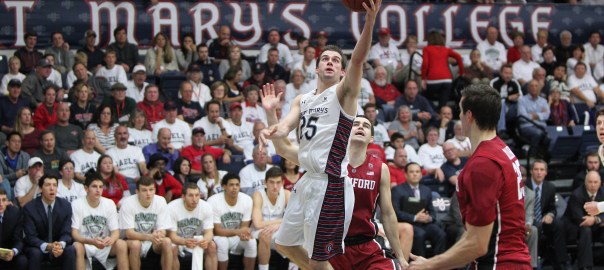
The photo above, courtesy of Gael photographer Tod Fierner, is emblematic of Rahon’s slicing and dicing job on the Cardinal.

Emmett Naar was only slightly less effective than Rahon, putting the emphasis on the long ball rather than the paint. Naar hit two three-point daggers in the latter part of the second half that removed any thoughts of a Stanford comeback. The usually self-contained Aussie was so excited after the second one — pumping his fists and swinging his arms — that a referee ran over to prevent him from decapitating any of the Stanford players.

Many players deserve credit for the Gael win besides Rahon and Naar, but I was impressed most by Evan Fitzner. Whether scoring 15 points on 4-6 shooting, flying around the basket after rebounds or giving a shooting clinic with his 5-5 free throw performance, Fitzner was a force. The stat sheet credited him with only 6 rebounds, but he had his hands on many more in a relentless pursuit of any airborne basketball. I was going to give him  credit for shutting down Stanford’s Rosco Allen (1-5, two points), but closer analysis showed several Gaels combining to keep Allen — one of Stanford’s biggest weapons — from becoming a factor. The Gaels exposed many weaknesses in Stanford, but Allen’s complete non-productivity was the biggest.

It is a shame that Branch and ESPN combined to make the telecast a bouquet to Dawkins, but the Gaels’ performance was good enough to erase any bad memories.

Toppling the tree

You can almost feel sorry for Stanford head coach Johnny Dawkins. Possessing a gold-plated resume (Duke All-American, nine-year NBA star, assistant coach under Mike Krzyzewski), he stepped into a program that had flourished under his two immediate predecessors: Trent Johnson took the Cardinal to three NCAA appearances and one NIT Championship in four years, while Mike Montgomery achieved legendary status in his 18 years with 10 NCAA appearances, including Stanford’s first and only Final Four appearance in 1998.

But…while not exactly floundering under Dawkins, the Cardinal haven’t reached Montgomery-Johnson heights either. Entering his eighth season, Dawkins can boast of a Sweet Sixteen finish in 2014 and two NIT championships. Usually, however, Stanford is a mid-to-low pack finisher in the Pac 12, and heads into this season picked 9th by the media.

So, does that mean Stanford is ripe for upset by Randy Bennett’s Gaels on Sunday night in Moraga?

No, it doesn’t.

Dawkins has a roster filled with four-and-five-star recruits, most of whom were national top 50 or 100 high school players. The Cardinal’s projected starting lineup against the Gaels (using its first two games as a guide) features 6-8 forward Reid Travis, a 5-star, top 50 player, and 6-9 Rosco Allen, a 4-star, top 100 player; 6-5 guard/forward Dorian Pickens, Arizona’s Player of the Year in 2014 and a 4-star pick; and one of the Allen twins, Marcus and Malcolm, who traded accolades: Malcolm, a top 100 selection according to Scout, was Nevada POY in his senior year, while Marcus was rated higher by Scout (#28 nationally). Marcus has been sidelined by injury this season, so Malcolm has stepped in.

It makes you wonder what a team has to do to win more media respect in the Pac 12. Apparently the graduation of its top three players, Chasson Randle, Anthony Brown and Stefan Nastic, dimmed Stanford’s prospects. Another factor was the preseason injury (broken arm) suffered by designated point guard Robert Cartwright, whom Dawkins was grooming to replace Randle. With Cartwright gone for the year, little-used shooting guard Christian Sanders has moved to the point.

One face Gael fans were hoping to see for the first time in Moraga, Stanford center Grant Verhoeven, probably won’t suit up after suffering a heel injury. Verhoeven, a highly-recruited post player out of the Central Valley, narrowed his college choices to Saint Mary’s and Stanford in 2012 before choosing the Cardinal. He has been hampered by injuries throughout his Stanford career, so it is hard to indulge in “what ifs” concerning a Gael career that didn’t happen. Besides, his major is Earth Systems, so Saint Mary’s probably never had a real shot at him.

The Match-ups

The graduation of Nastic, a 6-11, 245-lb back-to-the-basket post player, deprives fans of a low-block battle with Gael center Jock Landale. With no true center, Stanford utilizes the twin forwards Travis and Allen, bringing in 6-8 Michael Humphrey off the bench. This will be the first time in the young season that the Gaels’ Landale, Dane Pineau and Evan Fitzner will face opponents of similar size and ability. Allen, a senior, should present the greatest challenge to the inexperienced Gael forwards.

In the backcourt, the unsung Saint Mary’s duo of Joe Rahon and Emmett Naar will get an opportunity to prove their mettle against more heralded opponents. Sharing playing time with point guard Sanders have been the 6-5 Pickens and 6-3 Malcolm Allen. If Scout and Rivals ratings mean anything, the Gaels will be outmanned, but Rahon has faced bigger challenges in the ACC, and Naar seems unperturbed by any competition.

Fans can catch Stanford in action against SMU tonight at 8:30 p.m. on ESPN2. SMU has risen to near-powerhouse status under coaching and NCAA-infraction legend Larry Brown, but Brown won’t be making the trip to Palo Alto. He is sitting out a nine-game suspension after his latest brush with NCAA regulations — a small matter of an assistant coach taking exams for a player. That beef will also keep SMU out of the NCAA tournament at the conclusion of this season.

And the winner is…

Anybody’s guess. The Gaels have faced media skepticism similar to Stanford’s since the graduation of their entire starting five. Like Stanford, they have won their first two games, albeit more impressively than Stanford. The Cardinal had to go to overtime to beat Wisconsin-Green Bay, a predicted 5th-place finisher in the Horizon League,  93-89 in their opener, but bounced back to trounce Charleston Southern, picked 7th in the Big South Conference, by 93-59.

The Gaels handled D2 competitor San Francisco State by 24 points and MAAC contender Manhattan by 26. Both teams played their first two games at home, but Stanford doesn’t have to travel very far to Moraga on Sunday night (ESPNU, 8:00 p.m. Pacific).

It may be a culture shock for the Cardinal, however, moving from the comfortable confines  of Maples Pavilion to the decidedly uncomfortable two-car garage known as McKeon Pavilion. Saint Mary’s fans, a notoriously fickle lot, may be inspired by the prospect of ESPN cameras to show up in force — Gael Force, that is — or they may not.

They were present en masse for the opener against SF State, but apparently were too busy studying for last Monday’s Manhattan contest — only a few hundred wandered over to McKeon. A raucous crowd unnerving fledgling Stanford point guard Sanders is one scenario Gael followers  can savor, but a frontcourt beat-down of Saint Mary’s novices is something Stanford fans might be contemplating. Take your pick.

Being Naar-cissistic

Gael guard Emmett Naar made 63% of his three-point attempts during the 2014-15 West Coast Conference season. Admittedly, it was a small sample, 26 of 41 attempts. He usually attempted only two or three three-pointers, occasionally daring to try 6, occasionally trying none.

Extended to the entire season, Naar’s three-point percentage shrank to 45%, again on a relatively small sample — 78 attempts, of which he sank 35. A good three-point shooter is defined as one who makes better than 33% of his shots, which equates roughly to a 50% overall success rate (do the math). Nirvana for a three-point shooter is usually defined as anything more than 40%.

Again, Naar shot 63% in WCC action in his freshman season, a major factor in his selection to the all-conference team. Notwithstanding this somewhat startling statistic, Naar was not looked upon by outsiders as one of the Gaels’ potential leaders this season. More interest was generated by the eligibility of transfer guard Joe Rahon, freed from NCAA-required bench time after transferring from Boston College. Three promising freshmen guards, Tanner Krebs, Stefan Gonzalez and Franklin Porter, also elicited excitement.

In this space last week, I opined that the Gael leaders for 2015-16 would most likely be Jock Landale, Rahon and Calvin Hermanson. Naar outscored all of them in the Gaels’ opening season 80-56 win over D2 rival San Francisco State. The final tally in that game was Naar 27 points, the Big Three 21. Naar made 7-11 of his three-point attempts.

Naar eased up against Manhattan in the Gaels’ second game, settling for 15 points on 3-4 three-point shooting in an 89-63 shellacking of a team with NCAA aspirations. I say eased up because it looked as if he could have easily replicated his SF State performance if necessary. Over the two games, Naar shot 10-15 on three-pointers, a smooth 67%.

Both Gael opponents this season have employed zone defenses, reflecting the conventional wisdom that more stringent enforcement of hand-checking rules is going to cause an avalanche of penalties in college hoops. Naar is ideally suited to destroying zone defenses, and he can only hope that most Gael opponents subscribe to conventional wisdom.

Not physically dominating at 6-1 or so, not interested in (or capable of) playing “above the rim” as the ESPN commentators tout incessantly, Naar has feasted on finding holes in the zones. He finds the holes and backcourt teammate Rahon finds him.

Rahon, who has taken over and stabilized a Gael offense which sputtered last year under indifferent leadership, has racked up 18 assists against three turnovers in the two games. That’s a 6-1 assist-to-turnover record that statisticians rarely encounter.

Rest of the Story

Naar’s emergence is not the only surprising development in the early going. Although most have been pleasant, a few are concerning. Landale, the 6-11 center who showed so much promise in his freshman year, has not dominated in the paint despite facing opponents much smaller than he. In fact, Gael coach Randy Bennett has started redshirt freshman Evan Fitzner in place of Landale. Although Fitzner has demonstrated some low post chops, most observers think he will prosper more as a stretch 4, where his three-point shot will be put to most advantage. This development probably falls in the early-season tinkering category, and the ultimate configuration remains to be determined.

On the plus side, Gael fans have been pleased with the play of Gonzalez and another freshman, Kyle Clark. Gonzalez seems to have answered the question of who will back up starting guards Rahon and Naar, although Bennett seems loathe to pull Rahon off the court. See the careers of Mickey McConnell and Matthew Dellavedova as examples of this tendency.

Gonzalez is a supremely confident 6-2 combo guard, who earned Player of the Year honors in Pocatello, ID last year. He has seemingly never seen  a three-point opportunity he doesn’t like, hoisting 12 in the first two games. Since he has made six of them, Bennett is not complaining and seems confident in his ability. Interestingly, Gonzalez has reversed conventional wisdom about who, if anyone, the Gaels might redshirt this year.

Gonzalez suffered a serious injury shortly after arriving in Moraga last summer, variously described as a broken leg or an ankle injury (the Gael staff is tight-lipped about injuries). But he has bounced back and it now seems the coaching staff is considering hot-shot Aussie guard Krebs for possible redshirt status. Although both games have been bench-clearing breezes, Krebs has not made it to the floor. Even a single appearance would render the redshirt possibility moot, so it appears that possibility is on the coaches’ minds.

Clark is another pleasant surprise. A rugged 6-7, Clark is mobile and active on the floor. He led all Gael scorers against Manhattan with 16 points in 31 minutes, and seems ideally suited to foiling zone defenses. He flashes to the top of the key as the Gaels rotate the ball, and has shown he can pass effectively from that position or put the ball on the floor and attack the basket.

So far, so good, with Stanford on the horizon this Sunday (Nov. 22). Whether the Gaels celebrate Thanksgiving early or lick their wounds instead of their fingers will rest on how early-season trends hold up.


Say it IS so, Joe

“Joe was a guy ready to go. He was mature, tough as nails and had a great IQ for the game.”

Such is the recollection of Steve Donahue, the Boston College coach who recruited Joe Rahon out of high school in San Diego and welcomed him to an Eagles team he was trying to rebuild for 2012-13. Rahon moved into Donahue’s starting lineup immediately, started all 33 games and led the team in minutes played and assists. He finished his freshman season in the hyper-competitive Atlantic Coast Conference averaging 10.1 PPG and 3.7 APG. He scored 10 or more points 16 times, and torched Clemson for 26 points on 9-12 shooting, including 6-7 on three-point attempts, in February of 2013.

Rahon’s sophomore season was virtually a carbon copy of the first, but Donahue was not as successful, as BC slumped to an 8-24 record and the coach was let go. When Donahue’s departure was announced, Rahon decided to head back to his roots in the West and looked up Randy Bennett at Saint Mary’s. Donahue, now head coach at Penn in the Ivy League, remembers assuring Bennett that Rahon was someone who would fit in well in Moraga.

“After two years in the ACC, I told Bennett that Joe was someone he could rely on for a two-to-one assist-to-turnover ratio, to shoot threes in the high 30s [percentage] and to defend multiple positions,” Donahue recalled.

Now is the moment for Rahon to validate his ex-coach’s confidence. In so doing, he will have more responsibility than anyone else on the Gaels’ roster for overcoming a two-year slump in the team’s performance. Leadership is a fleeting quality, hard  to pin down but impossible to replace, and leadership is the outstanding trait Donahue ascribes to Rahon. Bennett has never thrown his team under the bus or singled out individuals for criticism, but he has let it be known that lack of leadership was the reason last year’s squad faltered so badly heading into the WCC tournament. Saint Mary’s failed to make it to the WCC championship game in each of the last two years after playing in it for five years in a row.

Adequate Supporting Cast?

If Rahon is a godsend for the Gaels at point guard, and his high school and college achievements suggest he is (22.1 PPG as a senior at Torrey Pines High School, including 27.1 PPG in the CIF playoffs), what about the players who will take the court with him as the Gaels kick off the 2015-16 season Friday night against San Francisco State? There is no shortage of critics who will point out that the Gaels’ entire starting five graduated last year and that there are only two upperclassmen on the roster. About that fact, Bennett has said, “Just because you’re young doesn’t mean you can’t be good.”

To be good, however, Bennett must get outstanding performances from at least two other Gaels — assuming Rahon lives up to his promise. Successful college teams need at least three standouts to meet their goals, and Saint Mary’s possesses additional candidates in center Jock Landale and small forward Calvin Hermanson. If Rahon, Landale and Hermanson shine for Saint Mary’s this year, the “not Gaels” will be forgotten.

Most observers of Bennett’s team act as if Landale didn’t exist in 2014-15. There is no question that Brad Waldow was Bennett’s horse in the post, and he rode that horse hard. But Landale appeared in 21 games last year and shot 61% from the field. He never played badly, seemed over-matched or failed to deliver rebounds, points or defensive stops when he was on the floor. Comparing Landale to Waldow and his predecessor as a star post man in Moraga, Omar Samhan, Landale looks pretty good. At 6-11, he is taller and more maneuverable than either of those standouts, and has a face-up jump shot that both lacked. There is no reason he can’t duplicate or surpass the achievements of Samhan or Waldow.

Hermanson was another lightly used asset last season, but it is hard to make the case he is not ready to take a prominent role. As a two-year Oregon High School Player of the Year, Hermanson was one of Bennett’s best recruits  back in 2012. Bennett has brought him along slowly, asking him to redshirt his freshman year and spoon feeding him into last year’s lineup. Like Landale, however, he performed at a high level in his time on the floor, shooting 44% on three-point attempts over 26 games. Sporting a trimmed, buff physique this year, along with protective goggles after being poked in the eye, Hermanson seems poised for a standout season.

Oddly enough given the criticism leveled at Bennett’s allegedly inexperienced troops, the final two starters are the most battle-tested on the team. Dane Pineau, a 6-9 power forward, has played considerable minutes in his first two years, alternating between backing up Waldow in the post and various other Gaels at forward. His averages over 31 games last year, 3.8 PPG and and 3.7 RPG, don’t scream “star,” but he did not look for his shot. Gael fans might compare him to Ian O’Leary, a rugged defender and rebounder who chipped in scoring when needed.

Emmett Naar, who should start alongside Rahon in the backcourt, has also been in the Gaels’ system for two years after a redshirt freshman season. He played in 30 games last year, started nine and averaged 6.3 PPG on 45% three-point shooting. He also averaged nearly 4 APG and committed only 30 turnovers to go along with 118 assists. He and Rahon should bring a high level of efficiency to Gael possessions.

Off the Bench

Who Bennett will call on to round out the 7-9-man rotation he prefers is the basis of much speculation among Gael fans. Based on an intra-squad scrimmage on Nov. 7, the first man off the bench may be 6-10 power forward Evan Fitzner. Fitzner is a highly-prized recruit out of southern California whom Bennett coaxed into redshirting his freshman year. Based on the scrimmage, Fitzner spent that initial season beefing up his body and polishing his smooth three-point stroke. People who have watched Fitzner closely since he came to Moraga compare his shot to that of Daniel Kickert, who was only the Gaels’ all-time leading scorer until Matthew Dellavedova came along.

If Fitzner is the prime frontcourt reserve, questions abound over who will provide backcourt depth. All Gael reserve guards — Tanner Krebs, Stefan Gonzalez and Franklin Porter — are freshmen, and it is not known who has emerged as the favorite to win court time. Krebs, with his 6-6 frame and silky release, is intriguing as a pure shooter, Gonzalez is a cocky ball handler and shooter who compiled an outstanding high school career (Player of the Year in Idaho), while Porter, son of former NBA star Terry Porter, may need more seasoning.

Add to this the Gaels’ Swiss Army Knife in guard/forward Kyle Clark, and there is much that will be revealed as the season progresses. Clark is a 6-7 dynamo who reminds observers of Matt Barnes in the NBA — filling in at a variety of positions, hustling, disrupting and generally making good things happen. He could emerge as a key cog in the Gaels’ machine.

Gaels or “not Gaels”?

There are many questions facing the Saint Mary’s College Gaels entering the 2015-16 season: how will they cope with an all-new starting lineup; can they get back in the hunt for a WCC title; do they have a chance for their first NCAA bid in three years?

But the overarching question hanging over Randy Bennett’s team is this: Does 2015-16 mark the end of the “not Gaels”?

The “not Gaels” have, over the past two seasons not won 25 or more games, not been competitive with Gonzaga in the WCC and not been a part of March Madness. More importantly, they have not been the polished, efficient squad that was considered the hallmark of Bennett’s system.

They were the “not Gaels.”

Starting in 2007-08, Saint Mary’s won 25 or more games for six straight years, tied for the WCC title in 2011 and won it outright in 2012. They started beating Gonzaga on a regular basis, punctuated by a 19-point thrashing (81-62) in the 2010 WCC championship game and another victory over the Zags in the 2012 championship. They played in the NCAA Tournament four times, advancing to the Sweet Sixteen in 2010, and the NIT in the other two years. Among their post-season victories was a 75-68 win over then-11th-ranked Villanova in the 2010 NCAA regionals, and NIT wins over Klay Thompson’s Washington State and Stephen Curry’s Davidson.

It is not as if the Gaels tanked in 2013 and 2014, winning 23 and 21 games in those years  and receiving  NIT bids after each season. But they lost seven conference games in 2013, finishing behind San Francisco for the first time since early in Bennett’s tenure, and crumpled at the end of last season with losses to Santa Clara in the final conference game and to Portland in the opening round of the WCC tournament. The loss to Santa Clara knocked the Gaels out of a second seeding in the WCC tournament and relegated them to the tourney’s second tier, where they suffered their first opening-round loss since Bennett’s early days in Moraga. They put the finish on 2015 with a dispirited 75-64 loss to Vanderbilt in the NIT.

What happened?

A short answer can be found in the careers of three great Gael players, each of them point guards and each of them perfectly suited to Bennett’s system. It is no coincidence that the careers of Patty Mills (2007-09), Mickey McConnell (2007-11) and Matthew Dellavedova (2009-13) paralleled the Gaels’ six-year span of excellence. Mills and Dellavedova are now playing in the NBA, while McConnell has had a successful career with a variety of European squads, and was the Dallas Mavericks’ last roster cut in 2014. It can be said that Bennett’s teams require a brilliant point guard, and, having one, can compete with college basketball’s best teams.

It looked as if Bennett had a successor to Dellavedova lined up even before the Aussie’s graduation. In November of 2012, Cullen Neal, a rangy 6-5 guard at Eldorado High School in Albuquerque, NM, signed a National Letter of Intent to attend Saint Mary’s. Neal was a national top-150 point guard averaging 26.5 ppg at Eldorado. He fit Bennett’s requirements perfectly  — a scoring point guard with high basketball intelligence and the ability to see the floor and pick apart the defense. With another excellent guard, Stephen Holt, remaining on his roster, Bennett began penciling in Neal’s name in a lineup that would include Holt mentoring the freshman until Neal took over the reins sometime in his freshman year. The reign of first-rate point guards would continue in 2013-14.

Except it didn’t.

Neal’s dad, Craig, was an assistant coach at the University of New Mexico at the time Cullen signed with Saint Mary’s. The other leading high school guard in New Mexico that year was Bryce Alford, son of New Mexico’s head coach Steve Alford, and it was known that Bryce would stay home and join his dad. The Neals reasoned that Cullen would be better off attending Saint Mary’s instead of stepping into a potential “whose coach’s son should be playing” controversy at New Mexico.

That scenario was scrambled, however, when Steve Alford accepted the head coaching position at UCLA, taking Bryce with him. Neal Senior was named to succeed Alford at New Mexico, and suddenly the idea of sending his son to Saint Mary’s didn’t seem so brilliant. When the dust settled, Cullen de-committed from Saint Mary’s, joined his dad at New Mexico and Bennett was left with a major hole in his lineup.

Add injuries to two other highly-anticipated Saint Mary’s recruits who could have helped make up for the loss of Neal — transfers Paul McCoy from SMU and Joe Coleman from Minnesota — and Bennett’s woes mounted. To top things off, the NCAA announced sanctions against Saint Mary’s in March of 2013 stemming from recruiting violations by  a Gael assistant coach — Bennett was cited for failing to monitor the assistant. That meant, among other things, the loss of two scholarships in 2014 and 2015 — four slots Bennett could have used to cover the losses of Neal, McCoy and Coleman.

The “not Gaels” were born.